Tuesday, August 23, 2011

The Evil Desires of Dr. Sparkle

My sinister plans for world domination have reached a new phase today, with the release of Chrontendo Episode 40.  Finally we have finished with the year 1988 and are poised to begin 1989.  You know the drill by know.   Fancy-ass 60 fps h.264 versions may be found on Archive.  A reasonable streaming version may be found on Youtube.  As always, I recommend the 60 fps videos.

In order to squeeze in the very last few games of '88, I tacked on two additional games, leaving Episode 40 with a total of 17 games.  Five of those are releases for the US market, from Konami, Sunsoft and Tengen. One of the Tengen games, Super Sprint did eventually get aJapanese release a few years later, by Altron, the same guys who published the Japanese version of Paperboy.

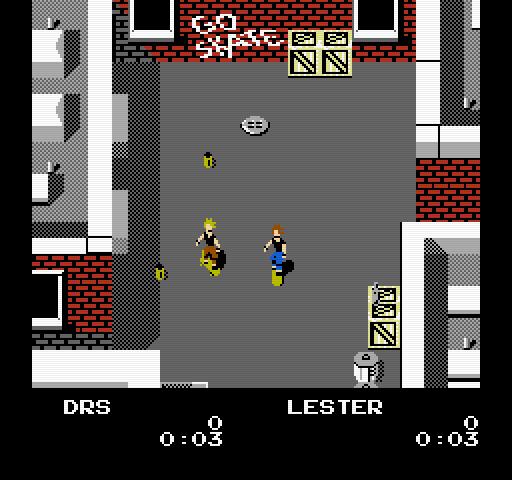
Skate or Die! marks the beginning of a new era of console gaming in the US.  It is the first Electronics Arts game released for a console; though in this case it was published by Konami under their Ultra Games imprint.  I've already mentioned my dislike for this game.  Most of my complaints center around the controls (and maybe also the ugly graphics.)  There were some genuinely baffling decisions made when Skate was ported to the NES, such mapping the kick, punch, jump and duck commands to the A button, while leaving the B button unused.


Sadly, warlock powers are missing from Platoon.

The two Sunsoft-published games are ports of Ocean Software's computer game Platoon and Bally Midway's arcade game XenophobePlatoon, which is based on the Oliver Stone movie (as absurd as that seems.) is an absolute mess on every single level.  The developers must not have had the vision or discipline required to make a cohesive game, so they stuck four short games together and called it a day.  Platoon comprises a side scrolling level set in a confusing maze-like jungle;  a first person shooter set in a series of tunnels; a short and boring shooting gallery level; and an extremely repetitive top down run-and-gun level.  Xenophobe is not as frustrating, but ends up being entirely pointless.  The arcade Xenophobe offered the novelty of three player co-op on a single screen. The NES reduced the number of players from three to two and was only capable of putting two enemies onscreen at once.


I wish I were joking, but no -- this is an actual screen shot of Xenophobe.

Tengen puts in an appearance with Vindicators and Super SprintVindicators, recently seen in the Chrontendo 1988 arcade round-up, is a top-down tank game, in which your stupid tank is constantly running out of fuel.  Super Sprint is basically a gussied up version of Atari's 1973 (!) arcade game Grand Trak.  It suffers from some of the weirdest damned physics in any racing game we've seen so far.  The cars have no weight and slip and slide around on the track like it was coated in Vaseline.   All five US games are their own sort of awful, and Vindicators is probably the best of bunch. 


I fail to see anything particularly "super" about Super Sprint.
 

Moving on, Episode 40 does contain one timeless classic: Rockman 2/Mega Man 2.


Dr. Wiley's mini-warship appears to be monogrammed.  Now that's classy!

Much ink has already been spilt on this game, and there is probably not much I can add.  MM 2 stands with Super Mario Bros. 3 as being the apotheosis of a video game sequel, at least in the NES era.  It takes everything that was good about the first game and expands upon it.  Instead of Mega Man's six robot masters, we now have 8.  Additional helpful items such as the energy tanks and the floating platforms are added in.  New, huge and awesome bosses are introduced. The level design has become even more creative and varied.  The music and graphics have been improved to a impressive degree.  A password system has been added so that you are no longer required to play it in one sitting.


What would a villain's base be without spiky crushy things dropping down from the ceiling?

The first Mega Man, released in late 1987, was just about the most inspired and sophisticated platform game we'd seen on the Famicom at that point.  Mega Man 2 raises that bar once again.  Other than SMB 3, I'm not sure that there was really anything on the system that could touch MM 2 in the action/platforming field.  Ninja Gaiden suffered an excess of cheap deaths.  Bionic Commando suffered from uninteresting bosses.  Blaster Master had those top-down sequences where you walked around on foot.  Mega Man 2 was the one where Capcom got everything just right.


Air Man has bizarre taste in exterior decoration.

The Blue Bomber clearly dominates this episode, but a few other decent games will be covered as well:

Tetris


If you are like me, you'll make a lot of errors due to the unusual control scheme.

There were a total of three versions of Tetris on the Famicom and NES.  This one, from Bullet Proof Software has the distinction of being the first released, but also the least fun to play.  For starters, you rotate a falling block by pressing down on the d-pad.  This will certainly interfere with your Tetris muscle memory. There is no option to increase the speed at which a block is falling; instead there is an option to instantly drop a block into place.  Thus, you need to be sure a block is positioned correctly or otherwise wait while it moves very slowly down the screen.

And the blocks do move quite slowly in this Tetris.  It's probably the mellowest version of Tetris you'll ever play.  Also: no two player option.  It's not fair to judge this game against later iterations of Tetris; but no one is going to toss aside Tengen's Tetris and play this one instead.  Still, BPS deserves major props for being the first guys to release Tetris on a console.  The fact that BPS had signed a contract that gave them explicit console rights for Tetris would lead to an epic legal battle a little later on.

Guevara/Guerrilla Warfare


Guerrilla Warfare rather obviously features Fidel Castro.

This SNK run-and-gun is hardly a great game in its own right.  It's really just another variation on the Ikari formula: guys with guns walking around in a jungle and shooting everyone who crosses their path.  However, it's a major step up from their console releases of Ikari and Ikari 2.  In the 1990s, SNK would develop a cultish fan following based around their Neo Geo platform.  But in 1988, SNK was still trying to shake off their reputation as producers of crap such as Athena.  That would take a few more years, but Guerrilla Warfare is a step in the right direction.

Pro Yakyuu? Satsujin Jiken!


This is colloquially known as performing a "1-8-7" on a law enforcement officer.

Released the same day as Mega Man 2, this Capcom game pokes fun at the glut of baseball and murder mystery games for the Famicom. It certainly stands out among the crowd of Portopia clones -- Capcom threw in RPG elements, mini-games and even a mini vertical shoot-em-up. 

The remaining titles this episode are not particularly notable.  But we are obligated to discuss every single Famicom game, so here is a quick rundown:

Roller Ball

A rather basic pinball game from HAL, based on an old computer pinball game they released for the MSX in 1984.  There's nothing really wrong with Roller Ball, but post-Alien Crush, it's hard to get too excited about a game like this.

Airwolf

You shouldn't confuse this horizontal shoot-em-up from Kyugo Boueki with the other Airwolf, from Acclaim.  This is better than Acclaim's version, but it's still a slightly boring shoot-em-up with dull enemies and no power ups.  For some reason, the boss battles are fought from a first-person viewpoint.  For a licensed game, it's not bad, I suppose.

Akira


The best looking parts of the game are copied directly from the comic or movie.

Speaking of licensed games, we have this adventure game from Tose and Taito, based on the popular sci-fi manga/anime.  Akira, the game, falls halfway between an adventure game and a Visual Novel, meaning there is more dialog and less interactivity than most Famicom adventure games.

Some of you might be old enough to remember the massive hype surrounding the Akira movie when it was released in the US in the late 80s.  I actually saw it in the theaters at that time, and was pretty unimpressed.  I felt the same way ten years later when I emerged from the theater after seeing The Matrix, wondering why everyone was so impressed by that movie.  Maybe I should give Akira a second chance someday?

Shoukoushi Ceddie


I told you this game was not going to be pretty, and I didn't lie.

This one takes the prize for oddest source material for a Famicom video game.  It's an adventure game based on Francis Hodgson Burnett's 1896 children's novel Little Lord Fauntleroy.  Yes, the very same book that started a craze for dressing up young boys in ridiculously sissified outfits at the turn of the 20th century (though, conversely, it also led to pants becoming a standard clothing option for young kids.)  Fuji TV's game is a eye-gougingly ugly mess that adds in some terrible "action" sequences to go along with menu navigation.

Moero!! Pro Soccer/Goal!

A non-terrible soccer game from Tose/Jaleco.  If soccer video games are your bag, then give this one a try.

Pro Yakyuu Family Stadium '88


This game seems strangely familar.

The third game in Namco's popular Family Stadium series.  Naturally, its virtually indistinguishable from the first two games in the series.  The character sprites are unchanged from the first game; in fact, the only obviously new element is that you can now choose between four different ball parks.  Please note, this title should not be confused with Tengen's R.B.I. Baseball 3, a completely separate game.

Ginga Eiyuu Densetsu


Prepare for some thrill-packed tactical spaceship action. No, not really.

Dudes in uniforms standing around in spaceships talking!  That's a good description of every animated Japanese space epic ever made, and also a pretty good summary of this game from Kemco.  There are some tactical space battles hidden somewhere in the game.  Naturally, Ginga is adapted from a series of sci-fi novels, manga and animated TV shows.

Tarot Uranai

Fortune telling simulation game number three!  This time, it's based on the tarot deck.  Rare's  Taboo: The Sixth Sense isn't seeming like such an oddball title, now, is it?

Next time: 1989 is upon us!  And it brings with it: Wrestlemania and Seseme Street games!  For now, you'll have to settle for checking out Episode 40 over at Archive or Youtube.


Saturday, August 20, 2011

As Per Your Request

For those wanting an animated '89 Dennou Uranai cat gif, here it is:


For those of you looking for Mega Man 2 infused Chrontendo goodness, you'll need to wait a few more days.  Check back shortly.  Chrontendo 40 will be ever-so-slightly longer than normal.  I've decided to squeeze in two additional games, so that we can completely wrap up 1988 this epsiode.  Sadly, those two games are semi-crappy Tengen releases: Vindicators and Super Sprint.

Sunday, August 7, 2011

California Darkness

Sorry for the hassle with Chrontendo Episode 39. Chris Osborn, of Juggle Chainsaws, pointed out that I referred to Fighting Road as Fighting Street several times during that segment.  Sure, I make a few errors or misstatements in many episodes, but repeatedly using the wrong title seemed to be serious enough to warrant a re-upload.  As for "The Adventures of Link," I didn't bother fixing that because, well... because Zelda II can go screw itself for all I care. Both versions of Episode 39 are still up on Youtube, but the revised version will, of course, be the one contained in the 25 disc Chrontendo Perfect (Remix) Collection Blu-Ray box set, when it comes out in 2027.

Work on Episode 40 has started, but I was a bit sidetracked last week due to my wife's birthday and a trip to the wilds of eastern California to check out the Black Chasm Caverns.  The typical images that come to mind when thinking of California are beaches, surfing, hippies, techno-geeks, and Hollywood.  All of this is completely accurate.  At this very moment I'm posting this from my iPhone while simultaneously carving a gnarly barrel off of Hermosa Beach.  However, the majority of California consists of farmland, desert, rednecks and quaint little towns in the middle of nowhere, in which every other building seems to be an antiques store.


At the bottom of the chasm you can see an underground lake in which live tiny, blind, scorpion-like creatures.

Anyway, Black Chasm is one of several caverns located in old Gold Rush country.  It's not too far from the town of San Andreas (GTA fans take note: San Andreas is a real city, though small and not particularly interesting).  While Black Chasm is not as huge or impressive as such well-known caverns as Carlsbad or Mammoth Cave, it's still worthwhile for its odd formations.


The "dragon" is the mascot of the caverns.

California culture certainly has a dark side to it; one that is manifested in video games such as Epyx's Winter Games and California Games, and now, in EA's Skate or Die!  Released by Konami's Ultra Games for the NES, SoD! is very much in the Winter Games mode: a collection of mini-games beset with inconsistent and needlessly oblique control schemes.  In fact, trying to play Skate or Die! caused Dr. Sparkle to fly into a bit of a rage.  Yet, despite its ability to infuriate the player, some folks out there remember it fondly today.  This is probably because back in 1988, we were young enough to have the time and patience (and lack of anything else worthwhile to do) required to figure out how to play this thing.  Even the instruction manual doesn't understand the controls -- it is completely wrong about the controls for one event.


All skaters had crazy mohawks back in the 80s.

Does anyone out there actually like Skate or Die?  Has anyone tried playing it recently?  I'm wondering if its just me.

Friday, July 29, 2011

Chrontendo 39: Sequel-Mania

Another hot slice of chronogaming goodness is served, courtesy of Dr. Sparkle! (Did that sound a just a little dirty? Good.)  Chrontendo Episode 39 is ready for you downloading and streaming pleasure.  Nice looking h.264 60 FPS versions may be found at Archive.  And a plain old streaming version may be watched on Youtube.  As always, I recommend the 60 FPS videos so you can see all the cool flicker effects, like the force shield in Gradius II.

Last episode left off in mid-December, right in the middle of the 1988 holiday shopping season. Tons of quickie cash-in games are crowding each other off the shelves of toy stores and electronics boutiques.  And you know what that means, right, kids?  Sequels!  An amazing five games this episode are sequels to earlier Famicom releases.  However, out of all the games covered this time, there are only a couple that anybody will actually give two shits about.

Gradius II is probably the finest game on display in Episode 39.  Konami was one of the most prodigious and consistent publishers in the earlier days of the Famicom, but in the second half of 1988, they slowed down a bit.  The Japan-only Gradius II could almost be considered a comeback, considering that their last big action title was Mad City/Bayou Billy.


Creepiest boss ever?

The arcade Gradius II (Vulcan Venture in Europe) was covered in the 1988 arcade roundup.  It was considerably more visually impressive than the first game, but it was also substantially harder.  Sure, the Vic Viper had some new laser and shield choices, but those didn't stand a chance against the waves of screen-filling projectiles thrown at you.  This made the arcade Gradius II punitively difficult.  Thankfully, in order not crush the souls of young Famicom players, Konami toned it down a bit for the console release.  A good deal of this is due to the downgrade in hardware; the Famicom couldn't handle that many enemies and bullets onscreen at once.  But Konami also made a few deliberate choices, such as beefing up the shield so that it could take multiple hits before disappearing.

Gradius II plays very much like the first game, only with more variety in the level design, and a whole bunch of brand new, enormous bosses.  Sure, the Core guy returns, and a few favorites from Salamander make an appearance, but line up of new bosses is perhaps Gradius II's finest feature.  There's even an honest-to-goodness boss rush level.


After playing Parodius, I can't help but think of a Las Vegas showgirl here.

The other big game this episode is Square's flawed but fascinating sequel to their company-saving hit, Final Fantasy.  If you've ever played Final Fantasy II, you'll recognize it as a classic example of the black sheep sequel, just like Zelda II and Castlevania II.  In this case, however, it set the pattern for the enitre series -- that every FF game would be dramatically different from its immediate predecessor.  This allowed it to stand in stark contrast to Enix's Dragon Quest series, in which each new game built upon the foundation of the one before it, by gradually introducing a few new elements into each sequel.


You can't open a damned treasure chest without finding monsters.

With Akitoshi Kawazu leading the design team, FF II eliminated character classes, experience points and levels, replacing them with a system in which your stats, weapon skills, and magic increase based on what skills or magic you use in battle. Likewise, max HP and MP increase as you lose HP and MP in battle.  This sounds fine on paper, but in practice it results in a very tedious system for leveling up, especially when it comes to magic.  It takes a long time to level up a spell: doing so requires casting it over and over and over.  For basic spells like Cure, this doesn't seem so bad.   But spells that are useful only occasionally will never be built up unless you use a cheat or exploit one of the game's (perhaps deliberate) bugs.  This is especially true with spells you acquire late in the game, such as Ultima.  You'll need to cast a lot of Ultima spells before it becomes very effective, which is ultimately (sorry!) more trouble than it's worth.  And I probably don't need to mention that if two characters have the same spells you'll need to level them up individually.


You have a lot of stats.

While the leveling mechanic sucks much of the fun out of the game, FF II is still quite notable for the many characters, items, monsters, and ideas that became series mainstays: such as Cid, Chocobos, Phoenix Downs, Dragoons, and so on.  One character, Lion Heart (or Leon Heart in some versions,) had a distant relative turn up years later in Final Fantasy VIII.  

Beyond those two games, Episode 39 is mostly a vast wasteland of boring and/or crappy games.   Here are the worst offenders:


Fantasy Zone II: The Teardrop of Opa Opa


It's called that because Opa-Opa once killed a guy in prison.

A complete waste of plastic.  There was already a far superior version of Fantasy Zone II on the Master System.  The Famicom port, published by Sunsoft, suffers from ugly graphics and ear-piercing music.  There is no need for this game to exist.

Indiana Jones and the Temple of Doom

I already bitched about this game a few posts back.  And I'm still all worked up about it.  Why do you start the game by hitting the "select" button instead of the "start" button?  What were you thinking, Tengen?  Were you not aware there was a button on the NES controller that was actually labeled START?!?

Even weirder, Tengen thought IJATTOD so valuable that they released an unlicensed version to compete with Mindscape's official release.

Family Trainer: Fuuun! Takeshi Shiro II


The umpteenth Family Trainer game and the zillionith Takeshi Kitano game.  Fuuun! Takeshi Shiro II caused Dr. Sparkle to have a bit of a breakdown this episode.

Kyuukyoku Harikiri Stadium: '88 Senshuu Shin Data  

Fake game alert!  This cart is really just the first Kyuukyoku Harikiri Stadium game rereleased with re-jiggered stats.


Captain Silver


Omigod!  Did we forget to feed the werewolf before we left?

The arcade Captain Silver was pretty annoying.  The Master System version, covered in Chronsega 6 was a huge improvement.  The Famicom port is notorious for its emaciated werewolves and is far worse than the other two versions.  One-hit deaths have been replaced by a lifebar, but your weapon and agility have been seriously downgraded.  Most enemies now take multiple hits to kill, so the net result is a game where it's actually easier to get killed than in the SMS Captain Silver.


And we have a few non-offensive carts as well:


The Triathron


This year's Triathlon had pretty high fatalities, due to giant whirlpools.

 The first of three racing games this episode.  Aside from the hilarious Engrish title, this KAC  game offers button-mashy swimming/cycling/running action.  It's pretty uneventful except for the deadly whirlpools in the swimming race.

Top Rider

An unabashed Hang On clone with a very unusual peripheral: an inflatable motorcycle featuring a built-in handlebar controller.  Yes, the player is supposed to sit on a big squishy airbag while playing Top Rider.

Cycle Race Roadman

My favorite of the three, Cycle Race is a simple little bicycle racing game. It works quite a bit better than the cycling sections in Triathron.

'89 Dennou Kyuusei Uranai

This would be another utterly pointless fortune telling/horoscope if it weren't for one thing - this cat:


A fat cat driving a teeny little UFO!

Micronics has created perhaps the greatest video game mascot ever.  Besides that, '89 Dennou has a few weird surprises, as shown in the video.


Paperboy

Another Tengen/Mindscape port of on old Atari arcade game.


Rampage

Data East releases a console version of Midway's classic urban environment destruction simulator.

Kaguya Hime Densetsu


The game gets a little judgmental at times.  I don't see what the big deal is.  She's unconscious, so she'll never know the difference.


Micronics developed this wacky adventure game, which does an irreverent take on the old Japanese legend of the Woodcutter's Daughter.  Apparently, this tale was a favorite among video game developers, because it also inspired Nintendo's Shin Onigashima, covered back in Episode 22.

Fighting Road


This is what fighting games looked like in the 80s.  

Another non-distinguished title from Toei.  This time it's a single player one-on-one fighting game.

 How would you feel if I told you that Chrontendo Episode 40 will finish up 1988 (almost!).  Yes, I'll be glad to move onto 1989, too.  One thing we have to look forward to in 1989 is more damned Western exclusive games.  1989-1991 is probably the peak of NES mania in the US, so the number of games aimed at the US market will explode during the next year or two.   I can hardly wait.  Mario's Time Machine, anyone?

Once again, head on over to Archive or Youtube and check out Chrontendo Episode 39.