By now, most of you will have absorbed at least some of the non-stop coverage of Sony's announcement of the PS4. We can't really call it an "unveiling" or a "revealing" or anything of sort, since Sony somehow managed to spend 3 hours talking about their new console without showing it, dropping a release date, or giving the slightest hint as to pricing. Instead, there was tons of typically silly sounding biz-speak like, "The living room is no longer the center of the PlayStation ecosystem. The player is." (I assume what this means is that Sony doesn't want you to think of the PS4 as a physical box that sits your living room, but as a more general brand that exists as some sort of Platonic Ideal, and can manifest itself it a variety of forms, such as, uh... the Vita?)
I have no idea exactly how well the PS4 is going to work for Sony. Every new game hardware system released in the last few years has performed under expectations. The Wii U and 3DS both sold less than Nintendo hoped for, and the Vita is basically a huge flop. I assume this is due to a mass exodus of casual gamers from dedicated hardware to smart phones and tablets. I can't help but wonder if we are experiencing the first stages of the decline of the game console right now. Regardless, my favorite piece of post-PS4 analysis has been this one from Gameological Society. It's a marvelously bitchy takedown of Sony's contention that the PS4's faster processor is going to save the game industry from its current malaise. Also, the fact that Sony has confirmed that your existing PSN games will not be transferable/playable on the PS4 is bound to piss off many gamers.
The Dreamcast sold over 4 million systems in the US in a year and a half. The Vita? Last month it moved 35,000 units.
And the good news I mentioned? If there's a silver lining here, it's that Sony seems to be hinting that the PS4 will not block used games, though they haven't come right out and explicitly said this will never happen. As connoisseurs of old games, we will all agree that a console that can't play used games has very limited appeal. It's sad to think that we've gone from eagerly anticipating rumored new features on upcoming consoles to dreading them.
As for the the bad news? Well, it came as no surprise, but Ziff Davis has shut down 1UP.com. This is a huge, huge shame, as 1UP was one of the few corporate-type game sites I actually liked. The quality of writing was always a few steps above most big game sites; they had a solid coverage of niche genres, such as retro games and RPGs; and they always seemed a bit more mature than the likes of Gamespot or IGN. The amount of content on 1UP has been slowly waning over the last couple years, in quantity, though not in quality. Lately they focused more on what the journalism world used to call "think pieces" instead of news and reviews. But the site has definitely felt somewhat empty and effete for a while now.
Some of the staff will be moving on to IGN; for example, Jeremy Parish already has some content up. Maybe there will a Retronauts revival at IGN! Many others, such as Bob Mackey, are being laid off, and my heart certainly goes out to them. For their sake I hope ZD has instituted some sort of decent severance package for them. God knows that takes some of the sting off unemployment.
I've been laid off twice myself, once from a company I was fanatically devoted to; the other time from a corporate entity I had no attachment to. The feelings ranged from anger/disbelief/bitterness to relief and something almost like euphoria. The constant worry that you experience when you think you are going to be laid off is terrible. There's a miasma of dread that hangs in the air when everyone in the office is expecting the worst. These things just eat away at you. Once the inevitable finally happens, you feel hugely relieved. In today's business world, there is no longer such a thing as job security. I was laid off from a hugely profitable Fortune 500 company which was actually hiring people at the same time my office was shuttered. The reason I lost my job was not due to lack of business -- it was because the lease on our building was up. It was more profitable to hire new people in other locations than it would have been to renew the lease or find a new building. It's a cruel world out there today.
Any way: 1UP, I'll miss you guys. Good luck on your future endeavors.
Your patience will be rewarded today with a new episode of Chrontendo. Yes, Episode 46 is finally ready.
As always, a high quality h.264 60 frames/sec version may be found on Archive.org here. (or rather, it will be in about a day.) And a streaming version in 30 frames/sec can be viewed on Youtube here. Just like the last episode of Chronsega, it will be available in HD at 720p.
This episode finds us precisely in the middle of 1989, as we cover a clutch of US NES releases from June, followed by July's Famicom releases. As I point out in the video, the popularity of the NES in the United States was nearing its peak at this time. One indication of this was the increasing number of game released for the NES. The ceaseless demand for product, combined with a huge backlog of Japanese games led to a flood of titles for the console in 1989-1990. In June 1989, for example there were around 15 NES games released, four of them US exclusives, compared to six games released in Japan that same month. Of those four games, two were crap, one was simply devoid of any interesting qualities, and the last one was Monster Party.
I've discussed Monster Party before, but it really stands out among the US-only games we've seen so far. Aside from just being really damned weird, Monster Party has a surprising amount of of blood and gore for a game with the Nintendo Seal of Approval on it. My theory? Certain big-name companies with close ties to Nintendo (such as Bandai) did not have to adhere to Nintendo's rules quite as strictly.
Monster Party is made of pure nightmare fuel.
It isn't clear why Monster Party never recevied a Japanese release. As many of you will know, a beta version of a planned Japanese verison of Monster Party was discovered several years ago. The cart has never been dumped/released to public, but we do have this video of the first level, which shows the game's original bosses were blatantly taken from popular movies.
Monster Party also has a shockingly dark ending, which depicts our hero Mark meeting a gruesome death. The developer, Human (i.e.: Bandai's "good" developer, as opposed to Tose) returned to the horror genre 6 years later with Clock Tower. It's interesting to note that Clock Tower was also heavily indebted to a western horror movie, Dario Argento's Phenomenon.
Mark's rather unsettling fate.
The other standout game today comes from a publisher with a much better reputation. Willow, from Capcom, is an action-adventure game in the Zelda mode, based on the Ron Howard/George Lucas film of 1988. The movie met with critical indifference and performed underwhelmingly at the box office, but it did receive three videogame adapations: a boring PC game from Mindscape, an solid platformer from Capcom, and the Famicom/NES game. Willow will not win any awards for originality, but from an aesthetic perspective, it easily beats the other Zelda clones we've seen so far. With its muted color scheme, and detailed, animated backgrounds, it's one of the best looking games for the console. The music is also phenomenal. Only the fact that it lacks the originality and freshness of Mega Man 2 or Bionic Commando keeps it from being top-tier Capcom.
Fantastic presentation makes willow stand out from other Zelda clones
A few other games also stand out this episode:
Dragon Ninja/Bad Dudes
The personalized getaway copter is a nice touch.
Quite frankly, if this game had been released under its Japanese title, Dragon Ninja, and all references to ninjas kidnapping president were removed, hardly anyone would remember Bad Dudes today. In the post Double Dragon/River City Ransom age, Bad Dudes seems just a little old-fashioned. The levels are completely unimaginative, and the same enemies appear over and over in every level. It does retain a certain level of cheesy '80s charm, but when you consider that Final Fight, the arcade Teenage Mutant Ninja Turtles, and Golden Axe all came out in 1989, you realize just how far behind the curve it was.
White Lion Densetsu/Legend of the Ghost Lion Faria: A World of Mystery and Danger
Ghost Lion is not the most original game is terms of art direction.
People always complain that no JRPGs received US releases back in the NES days, yet here are two counter-examples. White Lion Densetsu messes with the stardard JRPG mechanics. You receive no experience points after battle, weapons cannot be equipped, only used in battle as items, and battles rely heavily on summons rather than other party members. Despite having an original battle system, White Lion nevertheless lifts a few of its sprites pretty much directly out of Final Fantasy.
One odd thing about Legend of the Ghost Lion is that it is reasonably well-documented online; it has a wikipedia page, vidoes on Youtube, and various reviews. Yet no one seems to mention this one important fact: it was based on a movie! Piramiddo no Kanata Ni: White Lion Densetsu was a 1988 film directed by Koichi Nakajima. The director, while hardly a household name, did have at least one other notable credit. He was the first assistant director on Paul Schrader's Mishima: A Life in Four Chapters and was somehow involved in the Ridley Scott/Mike Douglas Japanese crime drama, Black Rain. Unfortunately, I could find virtually no info on the White Lion movie.
Faria - not the best looking RPG on the NES.
Faria draws a bit of inspiration from Zelda, but also from Falcom's Ys. The hero/heroine even looks a bit like Aldo from Ys. Faria was developed by Game Arts, who we'd previously encountered as the developer of Thexder. In the 90s they would get a reputation as an RPG company, thanks to the success of the Lunar and Grandia series. Game Arts brings a puckish sense of humor to Faria, with a plot twist involving poisoned caviar and a princess who resembles a caterpillar. Another notable name on the credits is Akihiko Yoshida, a fellow who will turn up as the character designer in many of Yasumi Matsuno's games, such as Final Fantasy Tactics and Vagrant Story.
In terms of bad games, only a couple really stand out.
I've already discussed Beam Software's Airwolf, published by Acclaim. It's a sort of like a worse version of Top Gun, with the awful "land on the aircraft carrier" part replaced with a pointless helicopter landing part. It's not so much bad, as it simply lacks any distinguishing or noteworthy features. It is completely unrelated to the Famicom Airwolf of the US computer game.
Oof! Faceplant, dude.
Regular Chrontendo viewers will know of my dislike for Epyx's "Games" series. So I assume you will not be surprised to find out I didn't care for the Rare/Milton Bradly release of California Games? This is the second version of California Games we've covered -- Sega released their own version for the Master System a bit earlier. I still find the game to be totally bogus, dude.
Other games this episode:
Oishinbo: Kyukyoku no Menu 3bon Syoubu
Food journalists have a lot of run-ins with the police.
A Japanese style adventure game, based on a food themed manga. We are fortunate enough to a have a solid translation of the game by The Snark. Unfortunately, being a Tose title, Oishinbo is not of the highest quality, with lumpy looking character art and bog-standard game design. Still, how many other video games make you choose the right method for gutting a monkfish and perparing its liver?
Tenkaichi Bushi Keru Naguuru doesn't exactly have a diverse roster.
We have not one, but two fighting game/RPG hybrids this episode! Hissatsu Doujou Yaburi from Sigma Entertainment resembles earlier fighting game hybrids, such as Culture Brain's Hiryū no Ken/Flying Dragon The Secret Scroll games (see Episode 33.) Tenkaichi Bushi Keru Nagūru uses a more RPG-ish top down overworld. It was developed by Game Arts, Masanobu Endo's company, so it has the better pedigree of the two. Neither one, however, works very well as a fighting game, due to the generic characters and slow, unresponsive controls.
Shin Moero!! Pro Yakyuu Kyuukyoku Harikiri Stadium Heisei Gannenhan
Shin Moero!! or possibly Kyuukyoku Harikiri Stadium. I forget which.
Alright, we had two RPGs, two fighting games, so why not two baseball games? Shin Moero!! is the latest in the Tose/Jaleco series known as Bases Loaded in the US. It's the third game in the series, but should not be confused with Bases Loaded 3, which was actually the US version of the fourth Moero!! Pro Yakyuu game. Not only did Shin Moero!! never get a western release, it also dropped the behind-the-pitcher camera from the first two games, and replaced with a weird 3/4 perspective view of the batter and pitcher.
Kyuukyoku Harikiri Stadium Heisei Gannenhan is another entry in Taito's baseball simulation series. Aside from the odd name, the game also features a cool 3D sculpture of a baseball player on the box art. Both games feature wall-to-wall annoying Ōendan music.
Zenbei!! Pro Basket/All-Pro Basketball
Another sub-Double Dribble basketball game hits the Famicom. This one is from Vik Tokai and Aicom, the developer of Jaleco's Hoops. Apparently Aicom couldn't figure out how to program full-court scrolling, ala Double Dribble, since Hoops featured half-court basketball and All-Pro uses a bizarre trick to avoid showing the entire court. When your player crosses the half-court line, the game freezes and the screen goes black for a moment. When everything reappears, the camera has moved 180 degrees and is now facing the other direction. This is annoying and confusing as can be.
Perfect Bowling
Even in a bowling game, they managed to squeeze in a panty shot.
A decent, if not particular exciting bowling game from Tonkin House
Igo Shinan
From Hect, an instructional Igo game. Someone must have been buying copies of this thing, since Hect released four sequels for the Famicom.
Shooting Range
Is it really a good idea to shoot the lollipop out of Frankenstein's hand?
A US only Zapper game from Tose/Bandai. It's just about the most generic Zapper game imaginable.
There were have it, another Chrontendo. Up next will be Chronturbo 4, which will carry us through June 1989 on the PC Engine.
I wanted to get just one last update in before Chrontendo Episode 46 is uploaded. I've spent much of MLK Day trying to get everything slapped together. Despite having the luxury of a three day weekend, I'm not quite finished. There were a number of other things occupying my attention: I had to get some new tires, and I also had a bit of cooking planned. Aside from day-to-day meals, I made a jar of pickles (Or rather, I started making a jar. They take a while.) But, much more exciting was baking a fruit cake.
I don't want to always be going off on cooking tangents, as I know some readers don't dig this stuff. However, I feel need to correct a common misconception that many of you may have: that fruit cake is terrible. Quite the opposite is true. A well made fruit cake is absolutely delicious. Obviously, you'd do well to avoid those store-bought cakes with the creepy red and green things in them. If you're going to use candied fruit, you should make it yourself. I whipped some candied orange peel for mine, seen here with the dates and apricots.
Side products from making the candied orange peel are peeled-but-unjuiced oranges and a very thick orange syrup. I'll have to figure out some use for the syrup.
Fruit cake ages well - the booze helps - so I made two cakes and am aging one for about a month and a half. I'll report the results to you then. The fresh one was excellent, however.
The Dord pointed out the recent news about Atari, Inc's chapter 11 filing. You've probably heard about this already. The familiarity of the name "Atari" means that most mainstream news outlets covered the announcement. While this is certainly interesting, we have to remember that this is simply the latest development in the ongoing saga of the rights to the name "Atari," which has been bought and sold numerous times. The current Atari, Inc has no real continuity with the original Atari. As you might recall from the Tengen company history we did a while back, Jack Tramiel's Atari Corporation (the guys behind the 7800, Lynx and Jaguar) ceased operations in 1996, and the name and rights were passed around a few times, ending up end the hand of Infogrames in 2003. The current Atari, Inc was originally a completely unrelated company called GT Interactive, which Infogrames purchased and renamed.
If anything, the "real" Atari died in 2003 when Atari Games was closed down by its owners Midway. Atari Games had remained a living, breathing game company until that point, with old-time employees like Asteroids creator Ed Logg hanging on until the very end. Warner eventually bought the Atari Games rights. Supposedly, Warner later sold these rights to Namco Bandai, who also took over the European division of the other Atari a few years ago. Thus stuff like Witcher 2 is published by Namco Bandai in Europe.
Over the next couple days I will finish editing Episode 46. Then it's a simple matter of producing a test version, correcting any obvious glaring errors, processing a final cut, and then processing the alternate versions (mkv, etc), uploading everything to Youtube and Archive -- and then you'll be able to enjoy Chrontendo 46!
One last minor announcement: there is now a new Chrontendo FAQ found in the upper left corner, below my profile picture. There's probably not much of interest to readers of this blog. I'll be linking to it in the new video, and it will be aimed more for folks who found Chrontendo on Youtube and don't know this blog exists.
You will be pleased to know that Chrontendo Episode 46 is nearing completion. There is only one game left unfinished, and then it's off to editing.
Episode 46 will feature four non-Japanese releases - that is, games that were created for the US market. One of them is Monster Party, but today I wanted to bring up a different title: Airwolf.
The US Airwolf is the second NES game based on the TV show, which, as I pointed out when covering the other Airwolf game, was cancelled in 1987. It was published by Acclaim, whose prior two US-only releases were both developed by Rare. (Wizards and Warriors and WWF Wrestlemania.) For Airwolf, Acclaim brought in a brand new developer to NES, Australia's Beam Software. It's interesting that all the publishers of US-only games for the NES (Acclaim, LJN, Hi Tech, etc) were outsourcing the work to overseas companies. American development studios were apparently all too invested in PC games to consider doing work for the NES.
Airwolf is a pretty awful game. Each level places your helicopter on a map which contains a few prison camps and refueling stations. The object is simple to move Airwolf to each camp to pick up prsioners, refuel if necessary, and then move the edge of the map, thus crossing the border. Almost all the action takes place in first person perspective from inside the cockpit. The results are not exactly visually thrilling:
There is nothing at all original in Airwolf. The game handles worse than most After Burner/Top Gun type games. The sound and graphics are ugly. In the screenshot above, you can see two enemy missiles headed towards you. They are represented simply by a bunch of black dots arranged into a circle. I guess creating a series of missile sprites in varying sizes was too much work or something. You can see the map in the middle of your cockpit's display. Acclaim tried to hide how boring looking the game is with some slightly deceptive packaging: the back of the box uses mostly screenshots from the intro and various cutscenes.
Airwolf is considered to be a pretty awful game, and in the US, Airwolf is the sort of thing we associate Beam Sofware with - lame licensed games. From the 8-bit era, Beam produced Back to the Future, the JVC-published Star Wars, Hunt for Red October on the Game Boy -- the sort of games that cause Youtube videogame critics to get all worked up and starting cursing and screaming. Their most notorious release was Power Punch II, originally created as a sequel to Punch-Out!! However, the resulting game was so terrible, Nintendo refused to associate themselves with it and sold it to a third party publisher, American Softworks. Somehow, amidst all the crap, Beam managed to turn out the Genesis version of Shadowrun, so their record is not 100% bad.
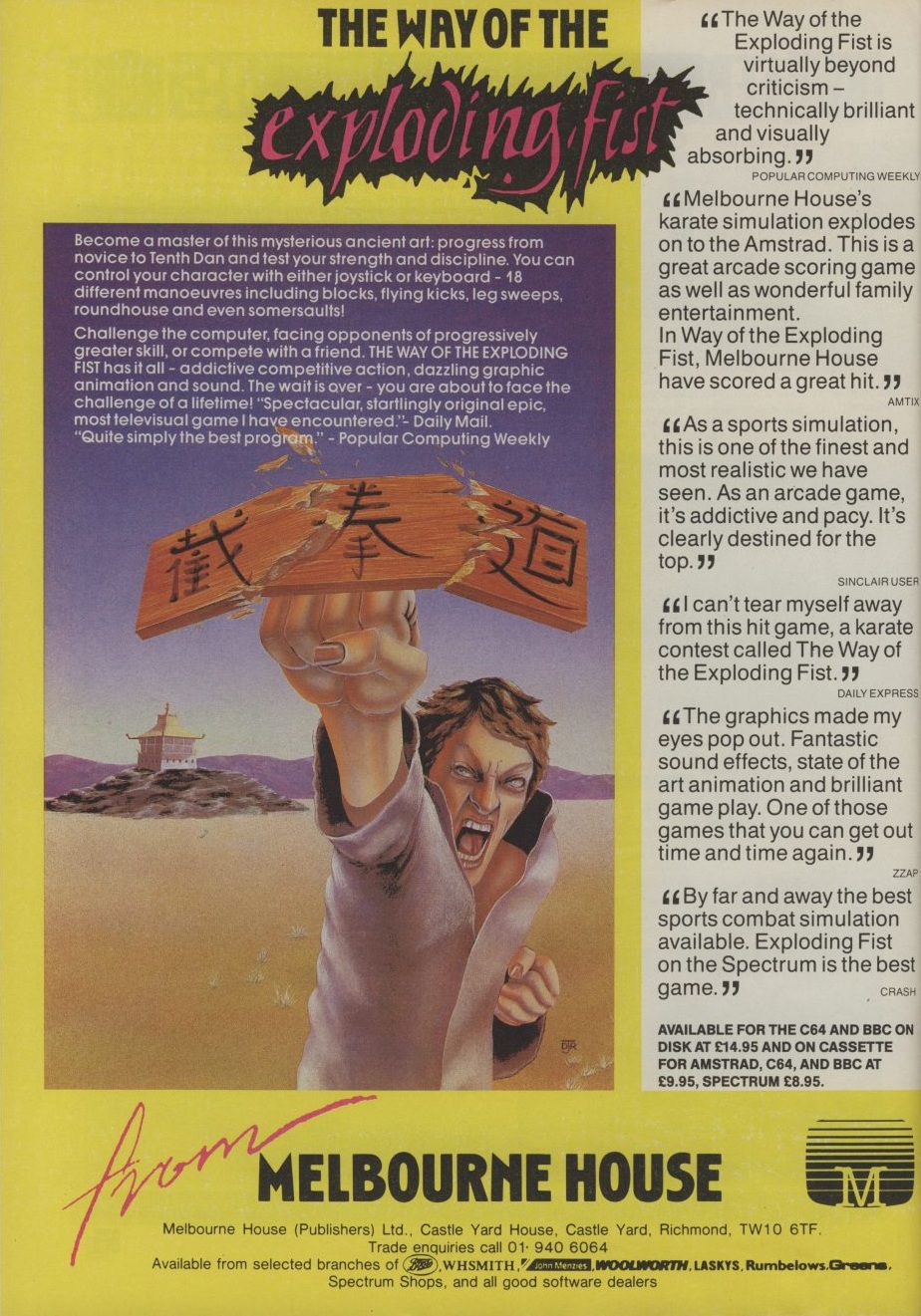
Yet, Beam's reputation outside of the US is very different. As a developer for games on the C-64, ZX Spectrum, etc, Beam (AKA Melbourne House) was considered to be a top-tier game company in the UK. You can find British and Australian sources describing them as legendary and pioneering. Prior to making NES games, they did have an international hit with The Hobbit, a text adventure game. But their most famous game overseas is Way of the Exploding Fist, a blatant rip-off of Karate Champ which improves a bit on the orignal. It failed to turn many heads in the US (Beam created an unreleased NES port), but is considered to be one of THE old-school games in the UK and Europe. At the time of its release, it received massive acclaim from gamers and the gaming press in the UK. Check out this ad for some over-the-top quotes from critics.
"Spectacular, startlingly original," "virtually beyond criticism," "Fantastic sound effects, state of the art animation," "Far and away the best sports combat simulation available." It's hard to reconcile that sort of praise with the game itself. I assume it was just a matter of the Exploding Fist being in the right place at the right time. Beam ending up winning the UK's Golden Joystick award for Best Software House of the Year in 1985. As another example of how UK and US tastes differed, in 1989 that award went to Ocean Software, another company known for tons of licensed shovelware. And the 1989 Golden Joystick for best console game went to.... Thunder Blade on the Sega Master System!
Beam continued to release games throughout the 1990s and 2000s, going through a few ownership and name changes in the process. As Krome Studios Melbourne, they produced forgettable titles like Viva Piñata: Party Animals and Star Wars: The Clone Wars – Republic Heroes. They ceased to exist as of 2010.
Moving on, I have another fine piece of Prog/Krautrock for the fans of that genre out there. This is sort of an oddity, a performance by Tangerine Dream from 1969. In the 70s T-Dream became a wildly successful electronic music act, creating music from behind massive banks of synthesizers. In 1969, however, they were a psychedelic rock band consisting of guitar, bass and drums.There is already one version of this on Youtube, but it was only in 240p, so I uploaded it in better quality.
The performers here are Edgar Froese, Klaus Schulze (who moved on to Ash Ra Temple and then a solo career in electronic music) and someone named "Happy" Dieter, whose identity remains unknown. The band performs on a rather distinctive fountain in what is actually the courtyard of a restaurant on Potsdamer St in Berlin. Sadly, this very cool looking courtyard is long gone, though the St. George Fountain still exits, having been moved to nearby Hindemithplatz. You can see the fountain as it looks today here. This particular jam is called the "Bath Tube Session" for reasons unknown to me. The film is a great look into the world of the German psyche scene of the time.


.jpg)


.jpg)