Tuesday, September 6, 2011
Herr Professor Doktor von Sparkle Präsentiert: Videospielenbücherkritik
Hello, everyone! I hope everyone had a wonderful Labor Day. For you folks outside the US, Labour Day or International Workers Day is usually a commemoration of the achievements of the working class in their struggle against capitalistic oppression throughout the last 100 years of so. For us inside the US, Labor Day means barbequing hotdogs, as per the instructions of our corporate overlords. My chili dogs turned out fantastic, thank you very much.
Dr. Sparkle has been hit with a bad case of the existential ennui lately, which means a slowdown in production of new Chrontendo episodes. I've also been busy with a few things the last week or so. One of them is putting together a new computer. One of the other things, unfortunately, was this:
It was not as bad as this looks. I'll explain next post.
However, we do have something a little different today -- I thought I'd talk about a couple books produced by fellow retro-game enthusiasts.
Many of you will be familiar with Gamespite. The main site is filled with high-quality game writing and the forums are a haven for old-school video game/furries/yaoi fandom. A couple years ago, Gamespite honcho Jeremy Parish came up with a clever idea: release a series of quarterly collections of reviews/articles from the site's various contributing writers in book form, then publishing those same articles, one at a time, on the web site.
"Sippin' Sizzurp in my ride, like Three 5?" No, that doesn't quite work.
So far, GameSpite Quarterly (now GameSpite Journal) has reached its ninth issue. The size of each issue varies, from #1's 150 or so pages, to #8's whopping 450+ pages. The meatiest two volumes, in terms of both size and breadth of content, are issues 5 and 8, which are reasonably in-depth looks at the NES and the Playstation 1, respectively. Each issue contains a series of articles about the console, arranged in roughly chronological order. Some articles are thematic; for example, Nintendo's legal battles with Tengen or the practice of importing NTSC Playstation games into Europe. But most articles discuss individual games. These can range in length from three sentences for Legend of Kage to five pages for the NES version of Strider. While these books can't come close to covering every game for each system, they do manage to get in the major US releases, plus a handful of lesser known titles and imports. Each issue is profusely illustrated with black-and-white screenshots and promotional artwork.
The GameSpite books are very dedicated to their subject matter. But if you want to see true obsession, you must turn to Hardcore Gaming 101's The Guide to Classic Graphic Adventures. This thing is huge: 772 pages and weighing about 2 1/2 pounds. Despite being in paperback format, its physical dimensions are that of a good-sized hardcover. It terms of content, it covers around 300 games and is nicely illustrated with B&W screenshots; though like GameSpite Quarterly, the screen captures can be a bit dark in places.
Not pictured: the heft of this tome.
The Guide focuses on the "classic" era of PC adventure gaming -- the mid-80s through the mid-90s. Virtually every well known graphic adventure game of that time period is covered, including the oeuvres of LucasArts, Sierra, Legend, Interplay, and so on. A few earlier games, such as the Zork series, and a handful of modern releases are discussed as well. A number of writers contributed entries, but the bulk seems to be written by Kurt Kalata himself. The overall tone is evenhanded and non-judgmental; even the worst games are described as "disappointing" or "flawed." I would guess that years of playing adventure games teaches one patience and forgiveness. Even the most well-loved games in the genre are filled with frustrating bullshit such as unfair deaths, impossible puzzles and sadistically frustrating action sequences. Adventure game fans learn to put up with a lot.
The book doesn't skimp on words.
Both Gamespite Quarterly and The Guide are not without their flaws. As self-published books they lack a professional editor, which often shows. Not that I'm complaining; it's beyond my abilities to proof-read a blog post of this length and not miss typos and errors. To self-edit a manuscript several hundred pages long and catch every single mistake would be just about impossible. Both books have problems with the most difficult word on the internet, "comprise." I was actually a little thrilled when I saw it used correctly early on in The Guide but later usage was inconsistent. Both books frequently (and exclusively) use "trope" in the modern, internet-y sense, but that probably bothers me only because I'm an curmudgeonly old bastard.
It is I who is being a dick.
The section on Star Trek games in The Guide contains the line "Like most great works of art, its appeal was not immediately recognized...." which is probably the most indefensible statement anyone has made about art, ever. Of course, it was used in reference to the original Star Trek TV series, so perhaps it was intended to be read ironically, as way of poking fun at the pretensions of Star Trek fans? GSQ 8 has a long and provocative article by Phil Armstrong on Breath of Fire IV, which goes against popular opinion and claims BoF IV to be the best game in the series and also the best Playstation RPG. It's a great article, but is bizarrely titled "Ying and Yang." Is that a typo or a joke that went over my head? I know Parish has a weakness for puns, so I'm thinking that it was intentional. Seriously, someone explain that to me. I feel really stupid every time I think about that title.
Despite such trivial imperfections, both publications get my most enthusiastic recommendation. Quality books on video games are not as common as they should be. Most are amateurishly written small-press works, or general video game histories which rarely get into the nitty-gritty of the games themselves. Or even worse, postmodern, academic books called "World of Warcraft and the Simulacrum: A Hermeneutic Perspective" or some such nonsense. Volumes of GSQ can be purchased on Blurb, and The Guide is available on Amazon, among other places. The Guide even comes in ebook format for those of you whose limbs are not sturdy enough to hold a 2 1/2 pound book and sip a soy latte at the same time.
Incidentally, the various comments about Akira, the movie, have whetted my appetite to revisit it. Maybe I'll like it more this time.
Tuesday, August 23, 2011
The Evil Desires of Dr. Sparkle
My sinister plans for world domination have reached a new phase today, with the release of Chrontendo Episode 40. Finally we have finished with the year 1988 and are poised to begin 1989. You know the drill by know. Fancy-ass 60 fps h.264 versions may be found on Archive. A reasonable streaming version may be found on Youtube. As always, I recommend the 60 fps videos.
In order to squeeze in the very last few games of '88, I tacked on two additional games, leaving Episode 40 with a total of 17 games. Five of those are releases for the US market, from Konami, Sunsoft and Tengen. One of the Tengen games, Super Sprint did eventually get aJapanese release a few years later, by Altron, the same guys who published the Japanese version of Paperboy.
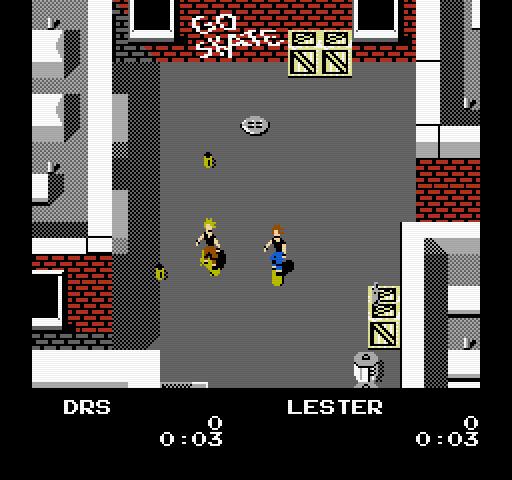
Skate or Die! marks the beginning of a new era of console gaming in the US. It is the first Electronics Arts game released for a console; though in this case it was published by Konami under their Ultra Games imprint. I've already mentioned my dislike for this game. Most of my complaints center around the controls (and maybe also the ugly graphics.) There were some genuinely baffling decisions made when Skate was ported to the NES, such mapping the kick, punch, jump and duck commands to the A button, while leaving the B button unused.
Sadly, warlock powers are missing from Platoon.
The two Sunsoft-published games are ports of Ocean Software's computer game Platoon and Bally Midway's arcade game Xenophobe. Platoon, which is based on the Oliver Stone movie (as absurd as that seems.) is an absolute mess on every single level. The developers must not have had the vision or discipline required to make a cohesive game, so they stuck four short games together and called it a day. Platoon comprises a side scrolling level set in a confusing maze-like jungle; a first person shooter set in a series of tunnels; a short and boring shooting gallery level; and an extremely repetitive top down run-and-gun level. Xenophobe is not as frustrating, but ends up being entirely pointless. The arcade Xenophobe offered the novelty of three player co-op on a single screen. The NES reduced the number of players from three to two and was only capable of putting two enemies onscreen at once.
I wish I were joking, but no -- this is an actual screen shot of Xenophobe.
Tengen puts in an appearance with Vindicators and Super Sprint. Vindicators, recently seen in the Chrontendo 1988 arcade round-up, is a top-down tank game, in which your stupid tank is constantly running out of fuel. Super Sprint is basically a gussied up version of Atari's 1973 (!) arcade game Grand Trak. It suffers from some of the weirdest damned physics in any racing game we've seen so far. The cars have no weight and slip and slide around on the track like it was coated in Vaseline. All five US games are their own sort of awful, and Vindicators is probably the best of bunch.
I fail to see anything particularly "super" about Super Sprint.
Moving on, Episode 40 does contain one timeless classic: Rockman 2/Mega Man 2.
Dr. Wiley's mini-warship appears to be monogrammed. Now that's classy!
Much ink has already been spilt on this game, and there is probably not much I can add. MM 2 stands with Super Mario Bros. 3 as being the apotheosis of a video game sequel, at least in the NES era. It takes everything that was good about the first game and expands upon it. Instead of Mega Man's six robot masters, we now have 8. Additional helpful items such as the energy tanks and the floating platforms are added in. New, huge and awesome bosses are introduced. The level design has become even more creative and varied. The music and graphics have been improved to a impressive degree. A password system has been added so that you are no longer required to play it in one sitting.
What would a villain's base be without spiky crushy things dropping down from the ceiling?
The first Mega Man, released in late 1987, was just about the most inspired and sophisticated platform game we'd seen on the Famicom at that point. Mega Man 2 raises that bar once again. Other than SMB 3, I'm not sure that there was really anything on the system that could touch MM 2 in the action/platforming field. Ninja Gaiden suffered an excess of cheap deaths. Bionic Commando suffered from uninteresting bosses. Blaster Master had those top-down sequences where you walked around on foot. Mega Man 2 was the one where Capcom got everything just right.
Air Man has bizarre taste in exterior decoration.
The Blue Bomber clearly dominates this episode, but a few other decent games will be covered as well:
Tetris
If you are like me, you'll make a lot of errors due to the unusual control scheme.
There were a total of three versions of Tetris on the Famicom and NES. This one, from Bullet Proof Software has the distinction of being the first released, but also the least fun to play. For starters, you rotate a falling block by pressing down on the d-pad. This will certainly interfere with your Tetris muscle memory. There is no option to increase the speed at which a block is falling; instead there is an option to instantly drop a block into place. Thus, you need to be sure a block is positioned correctly or otherwise wait while it moves very slowly down the screen.
And the blocks do move quite slowly in this Tetris. It's probably the mellowest version of Tetris you'll ever play. Also: no two player option. It's not fair to judge this game against later iterations of Tetris; but no one is going to toss aside Tengen's Tetris and play this one instead. Still, BPS deserves major props for being the first guys to release Tetris on a console. The fact that BPS had signed a contract that gave them explicit console rights for Tetris would lead to an epic legal battle a little later on.
Guevara/Guerrilla Warfare
Guerrilla Warfare rather obviously features Fidel Castro.
This SNK run-and-gun is hardly a great game in its own right. It's really just another variation on the Ikari formula: guys with guns walking around in a jungle and shooting everyone who crosses their path. However, it's a major step up from their console releases of Ikari and Ikari 2. In the 1990s, SNK would develop a cultish fan following based around their Neo Geo platform. But in 1988, SNK was still trying to shake off their reputation as producers of crap such as Athena. That would take a few more years, but Guerrilla Warfare is a step in the right direction.
Pro Yakyuu? Satsujin Jiken!
This is colloquially known as performing a "1-8-7" on a law enforcement officer.
Released the same day as Mega Man 2, this Capcom game pokes fun at the glut of baseball and murder mystery games for the Famicom. It certainly stands out among the crowd of Portopia clones -- Capcom threw in RPG elements, mini-games and even a mini vertical shoot-em-up.
The remaining titles this episode are not particularly notable. But we are obligated to discuss every single Famicom game, so here is a quick rundown:
Roller Ball
A rather basic pinball game from HAL, based on an old computer pinball game they released for the MSX in 1984. There's nothing really wrong with Roller Ball, but post-Alien Crush, it's hard to get too excited about a game like this.
Airwolf
You shouldn't confuse this horizontal shoot-em-up from Kyugo Boueki with the other Airwolf, from Acclaim. This is better than Acclaim's version, but it's still a slightly boring shoot-em-up with dull enemies and no power ups. For some reason, the boss battles are fought from a first-person viewpoint. For a licensed game, it's not bad, I suppose.
Akira
The best looking parts of the game are copied directly from the comic or movie.
Speaking of licensed games, we have this adventure game from Tose and Taito, based on the popular sci-fi manga/anime. Akira, the game, falls halfway between an adventure game and a Visual Novel, meaning there is more dialog and less interactivity than most Famicom adventure games.
Some of you might be old enough to remember the massive hype surrounding the Akira movie when it was released in the US in the late 80s. I actually saw it in the theaters at that time, and was pretty unimpressed. I felt the same way ten years later when I emerged from the theater after seeing The Matrix, wondering why everyone was so impressed by that movie. Maybe I should give Akira a second chance someday?
Shoukoushi Ceddie
I told you this game was not going to be pretty, and I didn't lie.
This one takes the prize for oddest source material for a Famicom video game. It's an adventure game based on Francis Hodgson Burnett's 1896 children's novel Little Lord Fauntleroy. Yes, the very same book that started a craze for dressing up young boys in ridiculously sissified outfits at the turn of the 20th century (though, conversely, it also led to pants becoming a standard clothing option for young kids.) Fuji TV's game is a eye-gougingly ugly mess that adds in some terrible "action" sequences to go along with menu navigation.
Moero!! Pro Soccer/Goal!
A non-terrible soccer game from Tose/Jaleco. If soccer video games are your bag, then give this one a try.
Pro Yakyuu Family Stadium '88
This game seems strangely familar.
The third game in Namco's popular Family Stadium series. Naturally, its virtually indistinguishable from the first two games in the series. The character sprites are unchanged from the first game; in fact, the only obviously new element is that you can now choose between four different ball parks. Please note, this title should not be confused with Tengen's R.B.I. Baseball 3, a completely separate game.
Ginga Eiyuu Densetsu
Prepare for some thrill-packed tactical spaceship action. No, not really.
Dudes in uniforms standing around in spaceships talking! That's a good description of every animated Japanese space epic ever made, and also a pretty good summary of this game from Kemco. There are some tactical space battles hidden somewhere in the game. Naturally, Ginga is adapted from a series of sci-fi novels, manga and animated TV shows.
Tarot Uranai
Fortune telling simulation game number three! This time, it's based on the tarot deck. Rare's Taboo: The Sixth Sense isn't seeming like such an oddball title, now, is it?
Next time: 1989 is upon us! And it brings with it: Wrestlemania and Seseme Street games! For now, you'll have to settle for checking out Episode 40 over at Archive or Youtube.
Saturday, August 20, 2011
As Per Your Request
For those wanting an animated '89 Dennou Uranai cat gif, here it is:
For those of you looking for Mega Man 2 infused Chrontendo goodness, you'll need to wait a few more days. Check back shortly. Chrontendo 40 will be ever-so-slightly longer than normal. I've decided to squeeze in two additional games, so that we can completely wrap up 1988 this epsiode. Sadly, those two games are semi-crappy Tengen releases: Vindicators and Super Sprint.
Sunday, August 7, 2011
California Darkness
Sorry for the hassle with Chrontendo Episode 39. Chris Osborn, of Juggle Chainsaws, pointed out that I referred to Fighting Road as Fighting Street several times during that segment. Sure, I make a few errors or misstatements in many episodes, but repeatedly using the wrong title seemed to be serious enough to warrant a re-upload. As for "The Adventures of Link," I didn't bother fixing that because, well... because Zelda II can go screw itself for all I care. Both versions of Episode 39 are still up on Youtube, but the revised version will, of course, be the one contained in the 25 disc Chrontendo Perfect (Remix) Collection Blu-Ray box set, when it comes out in 2027.
Work on Episode 40 has started, but I was a bit sidetracked last week due to my wife's birthday and a trip to the wilds of eastern California to check out the Black Chasm Caverns. The typical images that come to mind when thinking of California are beaches, surfing, hippies, techno-geeks, and Hollywood. All of this is completely accurate. At this very moment I'm posting this from my iPhone while simultaneously carving a gnarly barrel off of Hermosa Beach. However, the majority of California consists of farmland, desert, rednecks and quaint little towns in the middle of nowhere, in which every other building seems to be an antiques store.
At the bottom of the chasm you can see an underground lake in which live tiny, blind, scorpion-like creatures.
Anyway, Black Chasm is one of several caverns located in old Gold Rush country. It's not too far from the town of San Andreas (GTA fans take note: San Andreas is a real city, though small and not particularly interesting). While Black Chasm is not as huge or impressive as such well-known caverns as Carlsbad or Mammoth Cave, it's still worthwhile for its odd formations.
The "dragon" is the mascot of the caverns.
California culture certainly has a dark side to it; one that is manifested in video games such as Epyx's Winter Games and California Games, and now, in EA's Skate or Die! Released by Konami's Ultra Games for the NES, SoD! is very much in the Winter Games mode: a collection of mini-games beset with inconsistent and needlessly oblique control schemes. In fact, trying to play Skate or Die! caused Dr. Sparkle to fly into a bit of a rage. Yet, despite its ability to infuriate the player, some folks out there remember it fondly today. This is probably because back in 1988, we were young enough to have the time and patience (and lack of anything else worthwhile to do) required to figure out how to play this thing. Even the instruction manual doesn't understand the controls -- it is completely wrong about the controls for one event.
All skaters had crazy mohawks back in the 80s.
Does anyone out there actually like Skate or Die? Has anyone tried playing it recently? I'm wondering if its just me.
Subscribe to:
Posts (Atom)