Sunday, June 30, 2013

Do You Think They'll Drop the Bomb?


OK, kids, I came back from my vacation, almost immediately got sick, had to attend some out-of-town business last weekend -- and now I'm almost completely sure I have some kind of ear/throat infection.

Also, it appears I may have outed myself as a Grateful Dead fan with the title of that Serious Sam video I posted. Sorry if I have disappointed you, but no one's perfect.

That provides us with the perfect segue in the subject of today's post, one of the most intriguing and fascinating games Nintendo released for the Famicom. This game would not only be Nintendo's first RPG, but it was designed by a well known writer/media celebrity named Shigesato Itoi.  The game's setting would not be the standard fantasy/sci-fi worlds of most RPGs, but the world of suburban America, with characters resembling the cast of Peanuts. All of this sounds like it has a huge amount of potential, yet the final result fell quite a bit short

Oh, I get it now... "mother Earth."


We are, of course, speaking of Mother, released in July 1989, although the name given to its official English translation was Earthbound. Since it's US release was eventually canceled, Nintendo reused the Earthbound name for the 1995 SNES release of the sequel, Mother 2. To avoid confusion, the English version of Mother is often called "Earthbound Zero." The unreleased English translation turned up on a prototype cartridge which was subsequently made available to the public by Demiforce Translations.

Mother is an odd beast. Nintendo had originally focused on action/platform/sports games for most of its first party Famicom releases. In the years 1986-1988, a few new genres achieved massive success on the console -- RPGs, menu-based adventure games, and military strategy games.  Nintendo ventured into adventure games with the Famicom Mukashi Banashi games in 1987, and released its first mil strategy game, Famicom Wars, in 1988, but remained stubbornly resistant to RPGs until Mother's release in 1989.

The game has some rather obvious Peanuts references.

On paper, Mother looks like a winner. The story is stuffed full of interesting ideas that elevate it beyond the the typical "destroy the evil demon/wizard" plot of most Famicom RPGs. Familial alienation is a major them of the game. Each of the four main characters has an absent parent, with reasons ranging from overwork to unexplained disappearance to death. I understand, of course, that RPG protagonists are frequently orphans/castoffs, but in Mother the missing parent theme is foregrounded.

One character joins you in order to find her missing mother.

The writing is quite good, and many NPCs are full of character, such as the lazy mayor of Podunk or Loid's father, who you find hiding in a garbage can in a swamp. Mother is stuff full of charming moments; in the middle of the desert you find a guy who will take you on a sight-seeing tour in his airplane. In a bar in the town of Ellay your party will engage in a synchronized dance routine.  As for the music -- it's fantastic. Provided by Itoi associate Keiichi Suzuki and Nintendo's Hip Tanaka (Metroid, Kid Icarus, Duck Hunt....), Mother's soundtrack is one of best we've encountered in Chrontendo so far, capturing feelings of melancholy, nostalgia and eerie stillness.

So what's the problem with Mother? Well, having created interesting and unusual characters, settings and plot, the game designers simply took all this and bolted it onto a Dragon Quest chassis. The game's mechanics are taken direclty from Enix's RPG series. The same menus, the same black background during battles -- the same limited inventories -- the same "fight a random battle every two steps" deal. So if you liked Dragon Quest II, then you might be forgiving of Mother's old school approach to RPGs. And the grinding! So much grinding.... Even so, you'll find yourself struggling to keep your weaker party members alive during battles. Your stereotypical female magic user character, Ana, has some decent attacks, but ends up needing to defend or heal herself most of the time just to stay alive.

This could be confused with a Dragon Quest screenshot. But it's Mother.

Additionally, if you are a fan of lots of cool loot and gear, expect to be disappointed by Mother. You won't finds tons of cool weapons and pieces of armor, like in Final Fantasy. To illustrate this: the protagonist, Ninten, finds his first weapon, the plastic bat, at the very beginning of the game. In the first town, Podunk, I bought him the boomerang. Once I had the boomerang, there was no need to acquire a new weapon until I found a better bat shortly before the game's final area.  Thus, I spent 80% of the game with the same weapon. As for armor, the town of Magicant, which you reach pretty early in the game, has all the armor you'll ever need. There are treasure chests in Mother, but they tend to contain (very useful) healing items, or one-time use items that can be used during battle for offense purposes. If you're the kind of person who like to poke around every dungeon corner in hopes of finding the Kaiser Knuckle or Flame Sword, then Mother will disappoint you.

Enemy types are quirky and silly, but rarely do more than use physical attacks or shoot a laser beam at you. Status aliments exist, but you rarely get hit with them. I had a character get turned to stone once and got poisoned only a couple times. A few enemies perform very annoying suicide attacks that do insane amounts of damage, killing off weaker party members.  But for the most part, battles are entirely nonstrategic slugfests - you pound monsters with your weapons/magic while occasionally healing.

I guess even little kids need to get their groove on sometimes.

In summary, Mother is a game full of creativity, whimsy and imagination which is weighed down by its derivative, dull and frustrating mechanics. In other words, it's a JRPG. (Just kidding!) The game is worth a look, and I suppose its an essential game for hardcore fans of the Mother series.. But don't go into expecting an 8-bit version of Earthbound.

Once Chrontendo 47 is released, fans of squandered potential will get a double treat. Aside from Mother, we have Capcom's bizarre 8-bit version of Strider.


Thursday, June 13, 2013

Goddamn, Serious Sam


So I picked up the Humble Bundle Serious Sam package. Because, well... it was a fantastic deal. Just a reminder for those who have played Serious Sam, there are moments that are frickin' ridiculous.

This room is like the Battletoads of first person shooters. There are a good 300 enemies that spawn in this one room.


A quick heads up -- this weekend is my wedding anniversary, and I'm headed out to the coast for a few days. I be back on Monday and will update the Chrontendo Tumblr. Maybe I'll also cough up a few vacation pics of sea lions or something.

Saturday, May 25, 2013

Stooooouuuuuts!!!


Stouts! (and one porter)
Hey guys, I hope most of you will be able to take advantage of the three day weekend, at least those of you in the US. I'm in the midst of an office improvement project. Stage one is mostly cleaning all the crap out of my office.  But, I am making time for Chrontendo 47 (and photographing recent beer acquisitions.)  For non-beer nerds out there -- stouts, especially imperial stouts and chocolate/coffee stouts are very highly prized in the US.  Checking out Ratebeer's list of higest rated beers, we see that 13 our of the top 20 are imperial stouts. One particular beer, Founders Kentucky Breakfast Stout, caused another bit of a beer freakout when it was released a few weeks ago, with long lines, instant sell-outs, etc.

More Stouts!

Not quite as insane was the run for Firestone Walker's Parabola, which hit the shelves about a week ago. While every decent liquor store ran out immediately, I was able a find a few bottles at Whole Foods (which is actually sort of a great place to buy beer, since the beer geeks tend to overlook it.) Incredibly, I found two bottles of FW's Sucaba at a Bev-Mo the same day.

Last time, I announced the launch of the Chrontendo Twitter. Today I'll mention the Chrontendo Tumblr, which "soft launched" a week ago. There's not much on there yet, but it will consist entirely of screenshots of games from each upcoming episode. This will allow you to preview each new episode if you choose, and sort of monitor the progress.

Monday, May 20, 2013

Underdressed Teenage Girls and Robot Ninjas


I suppose those two things sum up the Japanese videogame experience quite nicely. Both of them will be on display today. Throw in tokusatsu heroes, golf games, mahjong, manga adaptations, turn-based/action RPGs, and panty shots, and you have summed up Chronturbo Episode 4.

Just like Chrontendo and Chronsega we've moved Chronturbo into a decent sized HD format on Youtube, so you can totally watch it fullscreen on your big-ass monitor and not have it look like shit. The Youtube version is here.  As always, I still recommend downloading the 60 frames per second h.264 version from Archive.org. 60 frames per second is the only way to experience the full glory of these things. Find it here.

Chronturbo 3 covered January through March of 1989, and Episode 4 basically takes us through the next three months. We actually reach the first week of July, which was just a little bit before the TurboGrafx-16 was released in the US. But for the moment, let's discuss the CD-ROM² add-on.

At first glance, its another Dragon Quest clone.

Despite being the most important technological innovation we've seen in the entire Chron series, the CD-ROM² hasn't born much fruit yet. There was a port of Street Fighter, which didn't make good use of the medium, and was a terrible game to boot. This was followed by one non-game and one barely-a-game (Bikkuriman Daijikai and No Ri Ko.)  In March Hudson gave us a very high quality release with Space Adventure Cobra, but this was mostly a menu-based adventure game. Finally, in June, Hudson produced their attempt at a killer app for the CD-ROM²: Far East of Eden: Ziria, a massive, ambitious Dragon Quest style RPG.  Far East of Eden outdid DQ in every department (except originality, I suppose.) Big name voice actors were brought in to record the game's many dialog scenes and its colorful, animated charterers were much more detailed than any found on a Famicom game. Musical legend Ryuichi Sakamoto created some of the in game music.

High res graphics set this apart from Famicom RPGs
 Far East of Eden ended up becoming quite successful in Japan. The second game in the series was massively popular, so much so that it ended up at the number 12 spot on that Famitsu readers' poll I discussed earlier. That puts it well above Link to the Past, Chrono Trigger, Final Fantasy VI or any Mario game! It's a shame than none of the Far East of Eden RPGs received a US release, or even a fan translation.

He's right behind you!

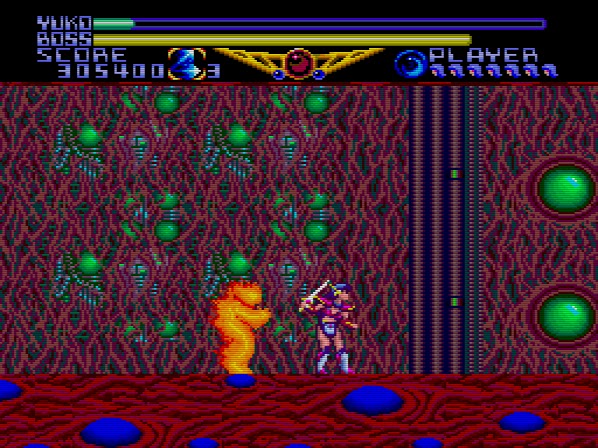
The other  game is a little different, but also quite important. Valis II may be a bit more familiar to you, since it was released in the US, by NEC. While not a great game, it is the first platformer for the CD-ROM², as well as the first third party published title.  It helped introduce a popular feature to consoles: the anime-inspired cutscene featuring skimpily dressed young ladies. By the end of its lifespan, the PC Engine was kept afloat by games based around naughty cutscenes. Also, since Valis II was one of the first CD games to be hastily dubbed into English, it started the grand tradition of really awful videogame voice acting.  This tradition continues to this very day.

A highly unlikely outfit.

As magnificent as Far East and Valis II are, they stand cold and shivering in the shadow of a far greater game: Gunhed/Blazing Lazers from Compile and Hudson. There is no denying the fact that Blazing Lazers is The Shit. Don't take my word for it. Google "best 10 TurboGrax games" or something, and check out the lists that people have put together. This is one the best games for the system and everyone knows it.

Cool robots = rad
What makes Blazing Lazers so great? Simple: radness. Try it yourself. Turn on the game and ask yourself, "Is there anything happening here that is not rad?" The answer will always be, "Nope. Every single thing on the screen is completely rad." Sure, some of the earlier shoot-em-ups we've seen have been pretty darned cool, such as Xanac, Salamander, R-Type, etc. But here, Compile just dialed up the coolness to extreme levels.

Space bubbles = also rad.


Bad Games:

The PC Engine is not known for its kusoge. There were some awful PC Engine games, and Energy and Jinmu Denshou would qualify as awful games by almost anyone's standards. Yet, there is one thing that redeems them: the music. Many of the main Famicom kusoge such as Athena or Super Monkey Daibouken have these ear-piercing, screechy, tuneless, music tracks. Yet Energy, despite being an ugly, buggy mess, manages to serve up some sick tunes. Jinmu Denshou -- an unpleasant Space Harrier clone which tries to integrate bits of platforming into the shooting action -- also has a pretty well done musical theme.

I have no idea what's going on here.


The RPGs:

Aside from Far East of Eden, we have two lesser RPGs, Makai Hakkenden Shada and Susano-ou Densetsu. Data East's Hakkenden is based on the same classic Japanese novel as SNK's Satomi Hakkenden, which we covered in Chrontendo 41.  The unusual thing about this game, is that rather than modeling itself after Dragon Quest, it is instead an extremely blatant rip-off of Falcom's Ys. Of course, the PC Engine version of Ys wouldn't be released until December 1989, making Hakkenden the Missing In Action to Ys's Rambo: First Blood Part II.

It's just like Ys, only terrible.


Susano-ou Densetsu, from Hudson, is a bit more original, though it is based on a Go Nagai manga, and is named after the Shinto deity.  In the world of video games, Susano-ou will familiar to Megami Tensei fans. It's a pretty large game, in terms of cartridge space (and price), but was overshadowed by Far East of Eden, which came out shortly afterwards.

This looks a wee bit like Dungeon Explorer.


The Golf Games:

Two golf games this time around: Hudson's Power Golf, which had colorful, dynamic box art (in Japan) and Naxat's Naxat Open, which had boooooring box art, and did not get a US release.  I suppose Power Golf is nominally the more interesting of the two, but both are just standard console golf games.

Arcade Ports from Namco:

Namco tends to focus on ports of earlier arcade games when it comes to its PC Engine releases. This time they dig deep into their vaults and pull out a port of Pac-Land, the pioneering game which is not that much fun to play nowadays. But it was the first Pac-man game to break away from the "running around in a maze" genre,. Instead it went on to create many of the conventions  of the side-scrolling platformer.

Ghosts flying airplanes?!


Wonder Momo is an odd, single plane beat-em-up with a tokusatsu theme. Like a lot of similar games, such as Sega's My Hero, it focuses heavily on knowing enemy patterns and finding the correct rhythm. It is also one of the most common HuCards in Japan, according to Kevin Gifford.

Yes, part of the game is a guy who tries to take an up-the-skirt photo.


Final Lap Twin - now here's an interesting one. Final Lap was a perfectly typical racing arcade game from 1987. For the console version, Namco decided to add an RPG mode. The results are very much like an improved World Tennis - that weird tennis RPG from Chronturbo 2.

Yes, this is somehow a racing game.


The Rest:

Fire Pro Wrestling Combination Tag -  The first Human published game! Having developed numerous games for other publishers, Human finally struck out for themselves with the first game in their long running wrestling series. Several key members of Human worked on Nintendo's Pro Wrestling, and Combination Tag resembles that game more than it does the later Fire Pro games. The high degree of customization that defined the Fire Pro series is not yet in place.

Screenshots of wrestling games often look a little risque.

Cyber Cross - You are a Japanese superhero. You walk from left to right and punch aliens that are walking from right to left.

Not much to see here.


Ninja Warriors - Port of the Taito arcade game that had the big, long screen, like Darius. It's basically Rush N Attack with ninjas minus most of the fun.

Wai Wai Mahjong - A mahjong game with colorful graphics and goofy characters.

There we have it. By my reckoning we'll need three more Chronturbos to finish off 1989. But that'll be a little while. Right now we need to deal with the next Chrontendo, which will feature a long-awaited game from Nintendo. Until then, check out Chronturbo 4 on Youtube and Archive.