
Every Nintendo Game In Chronological Order
Wednesday, February 26, 2014


Sunday, January 12, 2014
More F.E.A.R.
A couple posts ago, I broke my strict retrogaming format and wrote up an almost-sorta-modern game, F.E.A.R., a strange hybrid of FPS & horror game. Since I was sort of on a F.E.A.R. roll, I decided to give the two lesser-known sequels a shot. Today then, we'll take a very quick look at F.E.A.R. 2: Project Origin and F.E.A.R. 3 (no subtitle.)
F.E.A.R. was released at the tail-end of the PS2/Xbox generation, in 2005. It retained the older, Half Life style of FPS gameplay, that of walking into rooms, shooting shit up, grabbing ammo, and guzzling health packs. F.E.A.R. 2 was released in 2009, in an entirely different era of gaming. Its contemporaries were COD: Modern Warfare 2, Assassin's Creed II and Infamous, yet F.E.A.R. 2 still retains its predecessor's formula, albeit with a significant graphical update.
The first F.E.A.R. game ended withthe scary girl from Ring Alma Wade dropping some kind of Akira-style psychic nuke on the town of Fairport, then presumably killing the protagonist and the few remaining supporting characters. No surprise then, that F.E.A.R. 2 introduces a brand new protagonist, a standard issue FPS military dude named Sgt. Becket. The game's opening act takes place during the events of the first F.E.A.R. game, as Becket and his squad break into the luxury penthouse of the CEO of Armacham Technology. If you recall your F.E.A.R lore, you'll know Armacham was the evil corporation behind the whole supersoldier/Alma fiasco. At the level's end, you see Alma nuking the city, and you get knocked unconscious and squirreled away to some hospital with a city-sized top secret research facility in the basement.
Now, I don't pretend to understand the plot of the F.E.A.R games, but this time it somehow involves Alma returning and harassing you with spooky hallucinations and flashbacks. Also, the Replica soldiers return, though I have no idea who is controlling them. And, in a shocking plot twist, it turns out Sgt Becket is also the subject of an illicit supersoldier project. In F.E.A.R you traveled from location to location via helicopter, but in the sequel your ride has been downgraded to a humble armored transport vehicle. Locations seen the the game include the destroyed remains of Fairport, an elementary school which has yet another secret research laboratory in the basement, and best of all, a nuclear power plant which houses (once again) a secret research laboratory.
Gameplay wise, F.E.A.R 2 is almost exactly the same as the prior game. Use guns, grenades, and slow-mo to take out groups of enemy soldiers, who shout things like "He took out the whole squad!" on their intercoms. Between firefights, expect to see freaky hallucinations, specters appearing/disappearing, lights getting dim, and so on, as Alma tries to fuck with you. You actually get a few "hands on" encounters with Alma, as she runs and claws at you, and you need to frantically tap the mouse button to beat her back. These QTE events are one of a few new gameplay features in F.E.A.R 2. There is also one cool scene set on a moving train. And best of all, you play one section from inside a heavily armed mechsuit, which is capable of raining massive destruction down upon enemy forces. Other that that, expect to do a lot of climbing ladders and hitting switches.
The one area that distinguishes F.E.A.R 2 from the original is its visuals. Aside from the obvious improvements in PC graphics in the intervening four years, the developers have put a lot more eye candy into this game. The storage rooms, service tunnels, and courtyards of F.E.A.R have been replaced with much richer environments. The elementary school, for example, is crammed with books, posters, children's drawings, overturned desks, etc. The streets of the destroyed town of Fairport are suitably grim, with crashed airliners, piles of rubble and its residents turned into silent ash statues. There's much better use of large scale environments, particularly when you must make your way down the edge of the massive crater where Alma set off her A-bomb, or when you encounter the imposing cooling tanks of the abandoned nuclear facility.
F.E.A.R 2 is also a bit gorier and grimmer than the first game. Aside from blood and guts spilling more liberally, the theme of human experimentation, in particular experimentation on school children, is pretty disturbing. While not as original as its predecessor, it's probably the most enjoyable of the F.E.A.R games to play in 2014. However, what would a F.E.A.R game without a totally WTF ending? Like the first F.E.A.R., the game feels likes it's setting you up for a final boss fight against Alma. I should point out Alma appears in the second game in adult form and struts around nude most of the time. The game's climax (heh) finds you running around in dream world while engaging in QTE battles with a former team mate. However, the little cutscenes makes it clear that while this is going on, Alma is... how shall I put this? ...riding you like a wild pony. Yep, you basically get raped by Alma in F.E.A.R. 2. The battle ends abruptly and the final image is the visibly pregnant Alma grasping your wrist and forcing your hand to touch her stomach. UGO even put in on one of their click-baity lists, this one about weird game endings. (Monster Party also made the list.)
Someone must have liked F.E.A.R 2 because two years later a sequel was produced, not by original developers Monolith, but by a smaller company called Day 1 Studios. Previously, Day 1 had worked on the console ports of F.E.A.R, and had also produced a little loved FPS called Fracture in 2008. Perhaps as a result of the development changing hands, F.E.A.R. 3 (or F.3.A.R., as the title screen actually says) changes up the formula quite a bit. It also rewrites the story a bit, bringing back several characters from the first game, despite that fact that every single person in that game died. Yes, the "Point Man" is back, having somehow shaken off Alma's mid-air attack at the the end of F.E.A.R. He's been captured by Aramacham and is being kept in a South American prison. I don't recall the game giving you any good explanation for this. I'm also not sure why Armacham has a prison in South America. F.E.A.R. 3 begins with a cutscene of Paxton Fetel coming back to "life" in ghost form, complete with the Deadman-like ability to possess living people. He's on pretty good terms with the Point Man, despite having been killed by him, and even helps him bust out of jail. Fetel acts as the narrator/tutorial dude/travel guide guy throughout the game, frequently materializing and giving you some advice. As for the Point Man, he's gone from a faceless pair of gun-wielding hands to an angry looking, bearded guy who appears in the between level cutscenes.
F.E.A.R. 3 goes out of the way to give your nameless character a bit of backstory, including between level flashbacks depicting the childhood of Fetel and Point Man while being raised as super soldiers. You get your first glimpse of how much different F.E.A.R 3 is going to be from its predecessors quite early in the game. F.E.A.R. 3 is very much informed by newer FPS games, and features a slower style of gameplay involving heavy use of cover. Instead of running into a room and mowing down enemies in slow motion, you'll find yourself crouching behind crates, waiting for enemies to poke their heads up for a second so you can fire a round or two into their skull.
Add in a regenerating health system and you've got much longer, more deliberately paced firefights. The slow mo also feels sort of gimped; either you move slower while it's turned on, or it runs out sooner. I'm not sure which. The result is that you spend a good deal of time slinking around behind boxes, since stepping out into the open will get you sliced into tiny pieces by a hail of bullets.
On top of this, F.E.A.R. 3 tosses a an achievement system that has popups appearing every 2 minutes congratulating you on using cover for 60 seconds or killing two enemies using slow motion. This ties into an RPG style experience meter, which grants you longer slow mo meters, the ability to hold more ammo, and so on, as you "level up." This is done by finding certain glowing corpses, which you can "psychic link" to. I'm not sure what exactly the "psychic link" is, but it makes the corpse disappear and grants you experience points. I actually think F.E.A.R. 3 handles this better than the earlier games, in which you increase your health/slo mo bars by snooping around in out of the way corners, looking for glowing syringes. Another interesting feature is the ability to replay a level as Fetel, who uses psychic powers instead of weapons.
At times, F.E.A.R. 3 is barely recognizable as a horror-themed game at all. After you escape the dreary prison level, you end up fighting Armacham soldiers in the sun-drenched streets of an unnamed Latin American town. This level would not look out of place in a COD game. After hijacking a helicopter and flying it back the US (what kind of range do helicopters have, anyway?) you soon end up duking it out with more soldiers in a typical middle-class suburban neighborhood. In the first half of the game, the F.E.A.R. secret laboratories and and dark service tunnels are entirely missing. Alma, and some other scary ghost/monster thing, turns up from time to time, but the horror content has been dialed down a bit.
Despite this, there is plenty of creepy stuff in F.E.A.R. 3, much of which is based around apocalyptic anxiety. The freakiest level in the game's first half takes place in a ruined Costco, which has been taken over by zombie-like gangster/skatepunk cultists. Some pretty creepy stuff pops up in this level: banks of flickering wide-screen TVs, weird shrines everywhere, human carcasses hung on meat hooks in the freezer. The quasi-undead cultists continue to come after you even once you've blown off limbs, and eventually start strapping dynamite to their chests and bum rushing you. These guys appear without any explanation, but eventually Fetel theorizes their brains were "burnt out" by the Alma induced nuke. The influence of 28 Days Later and similar apocalyptic narratives can be heavily felt in these levels. The net result of all this is a game that feels less like earlier F.E.A.R. games and more like.... well, a lot of stuff that isn't F.E.A.R.
I'm not saying F.E.A.R. 3 is a bad game. It's a reasonably decent FPS with a bit of spooky stuff in it. I wish it fit in better with the previous games. I wish the it made even the tiniest bit of sense. (A US city is destroyed by a huge explosion, has subsequently fallen into mass anarchy, and weeks later a private corporation's security forces are going around killing survivors? Why hasn't every available US Army/National Guard been deployed to the area? Has the US government somehow collapsed?) It also just seems wrong the way the game makes Alma & Fetel into good guys, more or less. Alma actually appears and rescues you from Armacham forces early in the game. Apparently Alma's end-of-F.E.A.R. 2 pregnancy figures into the game at some point as well.
Bottom line: I initially decided to to plow all the way through F.E.A.R. 3 just so I could say that I finished it. However, around halfway through, after almost completing a lengthy level, the game lost my save file and made me restart the entire level. Yep, F.E.A.R. 3, just like F.E.A.R. 2 does not allow you to manually save your game, but instead using a single slot autosave feature. I'm not sure what happened, but I wasn't willing to replay that entire area, and I just called it quits. No big loss, I guess.
F.E.A.R.: I give this a solid B
F.E.A.R. 2: B+
F.E.A.R. 3 : C+
There you have it, the F.E.A.R. series in a nutshell, minus the expansion packs. Now you don't have to play them yourself!
F.E.A.R. was released at the tail-end of the PS2/Xbox generation, in 2005. It retained the older, Half Life style of FPS gameplay, that of walking into rooms, shooting shit up, grabbing ammo, and guzzling health packs. F.E.A.R. 2 was released in 2009, in an entirely different era of gaming. Its contemporaries were COD: Modern Warfare 2, Assassin's Creed II and Infamous, yet F.E.A.R. 2 still retains its predecessor's formula, albeit with a significant graphical update.
 |
| F.E.A.R. 2 has truly entered the era of Next-gen graphics. |
The first F.E.A.R. game ended with
 |
| You encounter evidence of all kinds of weird experiments in F.E.A.R. 2 |
Now, I don't pretend to understand the plot of the F.E.A.R games, but this time it somehow involves Alma returning and harassing you with spooky hallucinations and flashbacks. Also, the Replica soldiers return, though I have no idea who is controlling them. And, in a shocking plot twist, it turns out Sgt Becket is also the subject of an illicit supersoldier project. In F.E.A.R you traveled from location to location via helicopter, but in the sequel your ride has been downgraded to a humble armored transport vehicle. Locations seen the the game include the destroyed remains of Fairport, an elementary school which has yet another secret research laboratory in the basement, and best of all, a nuclear power plant which houses (once again) a secret research laboratory.
 |
| Horrible products of human experiements gone wrong fill F.E.A.R. 2. |
Gameplay wise, F.E.A.R 2 is almost exactly the same as the prior game. Use guns, grenades, and slow-mo to take out groups of enemy soldiers, who shout things like "He took out the whole squad!" on their intercoms. Between firefights, expect to see freaky hallucinations, specters appearing/disappearing, lights getting dim, and so on, as Alma tries to fuck with you. You actually get a few "hands on" encounters with Alma, as she runs and claws at you, and you need to frantically tap the mouse button to beat her back. These QTE events are one of a few new gameplay features in F.E.A.R 2. There is also one cool scene set on a moving train. And best of all, you play one section from inside a heavily armed mechsuit, which is capable of raining massive destruction down upon enemy forces. Other that that, expect to do a lot of climbing ladders and hitting switches.
 |
| Among the coolest parts is operating a powerful mech-suit. |
The one area that distinguishes F.E.A.R 2 from the original is its visuals. Aside from the obvious improvements in PC graphics in the intervening four years, the developers have put a lot more eye candy into this game. The storage rooms, service tunnels, and courtyards of F.E.A.R have been replaced with much richer environments. The elementary school, for example, is crammed with books, posters, children's drawings, overturned desks, etc. The streets of the destroyed town of Fairport are suitably grim, with crashed airliners, piles of rubble and its residents turned into silent ash statues. There's much better use of large scale environments, particularly when you must make your way down the edge of the massive crater where Alma set off her A-bomb, or when you encounter the imposing cooling tanks of the abandoned nuclear facility.
 |
| F.E.A.R. 2 contains a good amount of striking visuals. |
F.E.A.R 2 is also a bit gorier and grimmer than the first game. Aside from blood and guts spilling more liberally, the theme of human experimentation, in particular experimentation on school children, is pretty disturbing. While not as original as its predecessor, it's probably the most enjoyable of the F.E.A.R games to play in 2014. However, what would a F.E.A.R game without a totally WTF ending? Like the first F.E.A.R., the game feels likes it's setting you up for a final boss fight against Alma. I should point out Alma appears in the second game in adult form and struts around nude most of the time. The game's climax (heh) finds you running around in dream world while engaging in QTE battles with a former team mate. However, the little cutscenes makes it clear that while this is going on, Alma is... how shall I put this? ...riding you like a wild pony. Yep, you basically get raped by Alma in F.E.A.R. 2. The battle ends abruptly and the final image is the visibly pregnant Alma grasping your wrist and forcing your hand to touch her stomach. UGO even put in on one of their click-baity lists, this one about weird game endings. (Monster Party also made the list.)
 |
| Alma mostly appears in her adult, butt naked form. |
Someone must have liked F.E.A.R 2 because two years later a sequel was produced, not by original developers Monolith, but by a smaller company called Day 1 Studios. Previously, Day 1 had worked on the console ports of F.E.A.R, and had also produced a little loved FPS called Fracture in 2008. Perhaps as a result of the development changing hands, F.E.A.R. 3 (or F.3.A.R., as the title screen actually says) changes up the formula quite a bit. It also rewrites the story a bit, bringing back several characters from the first game, despite that fact that every single person in that game died. Yes, the "Point Man" is back, having somehow shaken off Alma's mid-air attack at the the end of F.E.A.R. He's been captured by Aramacham and is being kept in a South American prison. I don't recall the game giving you any good explanation for this. I'm also not sure why Armacham has a prison in South America. F.E.A.R. 3 begins with a cutscene of Paxton Fetel coming back to "life" in ghost form, complete with the Deadman-like ability to possess living people. He's on pretty good terms with the Point Man, despite having been killed by him, and even helps him bust out of jail. Fetel acts as the narrator/tutorial dude/travel guide guy throughout the game, frequently materializing and giving you some advice. As for the Point Man, he's gone from a faceless pair of gun-wielding hands to an angry looking, bearded guy who appears in the between level cutscenes.
 |
| This is you, in all your cutscene bad-assery. |
F.E.A.R. 3 goes out of the way to give your nameless character a bit of backstory, including between level flashbacks depicting the childhood of Fetel and Point Man while being raised as super soldiers. You get your first glimpse of how much different F.E.A.R 3 is going to be from its predecessors quite early in the game. F.E.A.R. 3 is very much informed by newer FPS games, and features a slower style of gameplay involving heavy use of cover. Instead of running into a room and mowing down enemies in slow motion, you'll find yourself crouching behind crates, waiting for enemies to poke their heads up for a second so you can fire a round or two into their skull.
 |
| Many, many boxes and crates to hide behind. |
Add in a regenerating health system and you've got much longer, more deliberately paced firefights. The slow mo also feels sort of gimped; either you move slower while it's turned on, or it runs out sooner. I'm not sure which. The result is that you spend a good deal of time slinking around behind boxes, since stepping out into the open will get you sliced into tiny pieces by a hail of bullets.
On top of this, F.E.A.R. 3 tosses a an achievement system that has popups appearing every 2 minutes congratulating you on using cover for 60 seconds or killing two enemies using slow motion. This ties into an RPG style experience meter, which grants you longer slow mo meters, the ability to hold more ammo, and so on, as you "level up." This is done by finding certain glowing corpses, which you can "psychic link" to. I'm not sure what exactly the "psychic link" is, but it makes the corpse disappear and grants you experience points. I actually think F.E.A.R. 3 handles this better than the earlier games, in which you increase your health/slo mo bars by snooping around in out of the way corners, looking for glowing syringes. Another interesting feature is the ability to replay a level as Fetel, who uses psychic powers instead of weapons.
 |
| F.E.A.R 3, the RPG? |
At times, F.E.A.R. 3 is barely recognizable as a horror-themed game at all. After you escape the dreary prison level, you end up fighting Armacham soldiers in the sun-drenched streets of an unnamed Latin American town. This level would not look out of place in a COD game. After hijacking a helicopter and flying it back the US (what kind of range do helicopters have, anyway?) you soon end up duking it out with more soldiers in a typical middle-class suburban neighborhood. In the first half of the game, the F.E.A.R. secret laboratories and and dark service tunnels are entirely missing. Alma, and some other scary ghost/monster thing, turns up from time to time, but the horror content has been dialed down a bit.
 |
| It is, however, extremely gory. Disgustingly so. |
Despite this, there is plenty of creepy stuff in F.E.A.R. 3, much of which is based around apocalyptic anxiety. The freakiest level in the game's first half takes place in a ruined Costco, which has been taken over by zombie-like gangster/skatepunk cultists. Some pretty creepy stuff pops up in this level: banks of flickering wide-screen TVs, weird shrines everywhere, human carcasses hung on meat hooks in the freezer. The quasi-undead cultists continue to come after you even once you've blown off limbs, and eventually start strapping dynamite to their chests and bum rushing you. These guys appear without any explanation, but eventually Fetel theorizes their brains were "burnt out" by the Alma induced nuke. The influence of 28 Days Later and similar apocalyptic narratives can be heavily felt in these levels. The net result of all this is a game that feels less like earlier F.E.A.R. games and more like.... well, a lot of stuff that isn't F.E.A.R.
 |
| The destroyed Costco is one of the better levels. |
I'm not saying F.E.A.R. 3 is a bad game. It's a reasonably decent FPS with a bit of spooky stuff in it. I wish it fit in better with the previous games. I wish the it made even the tiniest bit of sense. (A US city is destroyed by a huge explosion, has subsequently fallen into mass anarchy, and weeks later a private corporation's security forces are going around killing survivors? Why hasn't every available US Army/National Guard been deployed to the area? Has the US government somehow collapsed?) It also just seems wrong the way the game makes Alma & Fetel into good guys, more or less. Alma actually appears and rescues you from Armacham forces early in the game. Apparently Alma's end-of-F.E.A.R. 2 pregnancy figures into the game at some point as well.
 |
| Trashed suburban homes represent anxiety over the death of the middle class. |
Bottom line: I initially decided to to plow all the way through F.E.A.R. 3 just so I could say that I finished it. However, around halfway through, after almost completing a lengthy level, the game lost my save file and made me restart the entire level. Yep, F.E.A.R. 3, just like F.E.A.R. 2 does not allow you to manually save your game, but instead using a single slot autosave feature. I'm not sure what happened, but I wasn't willing to replay that entire area, and I just called it quits. No big loss, I guess.
F.E.A.R.: I give this a solid B
F.E.A.R. 2: B+
F.E.A.R. 3 : C+
There you have it, the F.E.A.R. series in a nutshell, minus the expansion packs. Now you don't have to play them yourself!
Sunday, December 15, 2013
The Odd Case of Content ID
By now many of you will have heard of Google unleashing a metric shit ton of Content ID notices for Youtube content, specifically videogame related content. What has happened is that the larger Youtube affiliates and the Multi Channel Networks -- the big guys - are suddenly being scanned for potential matches. As a result, many, many gaming-related channels are suddenly being hit with dozens, hundreds or even thousands of Content ID match warnings. For commercial channels, this can mean loss of revenue, ads being placed in videos, etc. As you can imagine, Youtubers are freaking the fuck out over this.
Chrontendo is not a monetized channel, so this particular change doesn't affect me. It is quite obvious that Youtube is gearing up to make some changes in the way it deals with monetized content. However, there are some rather bizarre things about these Content ID notices. First of all, the notices are being issued overwhelmingly to gaming channels. Also, a number of videogame companies, Capcom, Valve, Naughty Dog, and others are making statements saying they are not behind the notices.
What seems to be driving the notices is not the game content specifically, but instead, the music. A lot of reports are coming in from a digital music distribution company called Idol. Several little known music companies seem to be popping up in the content claims, and some of these claims are pretty unusual. Take for example this video, from the Youtube user, Gopher, who gives examples of the claims he's been receiving.
One of the claims is about the Billie Holiday song "Crazy He Calls Me." The message states that the recording is administered by one "Pirames International SRL." This is some sort of music company based in Milan. Their website is pretty barren. Their LinkedIn profile claims "1-10 employees," and they have a Youtube channel which focuses mostly on Italian artists, though I see Marilyn Manson and Amanda Palmer listed as well. It seems odd that Marilyn Manson's new album would be handled by this tiny little company in Italy, but the US it was released though an indie label, Cooking Vinyl, so its entirely possible Pirames is Manson's Italian distributor. But what about the Billie Holliday song? "Crazy He Calls Me" was recorded for Decca, and I'm pretty sure those recordings are currently owned by Universal. Since Universal is a huge, multinational music company that controls a sizable portion of all the music in the world, it is pretty unlikely that these Pirames guys ended up with the rights to that song. The other song, by Eddy Christiani is listened as being from APM Music, a large licensing company. Presumably they are the ones who licensed the song to Bethesda for use in the game, so this one makes a bit more sense. Though Eddy Christiani, a Dutch musician, recorded that song in 1948, meaning it would have been in the public domain in Europe when Gopher made that video. (I think Gopher is based in Europe. Not sure how international copyright law would factor in, since Youtube is based in the US.)
The pattern seems to be content being flagged not by the owners of the music, or the game publishers, but the music licensing companies. What strikes as strange is the utter triviality of these content claims. How much value does a few moments of background music in a Let's Play video have? Very little. Yet much more valuable properties are flagrantly being posted on Youtube without the rights-holders' permission.
What's my connection to all this? Well, I received a Content ID notice for the F.E.A.R. video I uploaded in my last post. The supposed rights holder was, again, some obscure music company. The artist/song in question pulled up absolutely zero matches in a Google search. The company's website didn't give much info on what sort of musical services it offered. But the crazy thing was this: the part of the video in question did not really contain any music. The only sounds were in-game footstep sound effects. There was also some kind of barely audible ambient background drone that may have been considered as music.
For those who are hit with a Content ID match, Youtube has an option to remove the offending music. I did this, and I far as I can tell, the only thing it did was remove around 1 second of that background drone. If you watch the updated video now, it's not even noticeable. It's after the part where I jump out the window, right the before big explosion starts, right at about 14 seconds in. Listening to the original video, I'm not even sure anything was removed, as the background noise can't be heard as clearly in the YT video as it can be in the original video capture.
Incidentally, I had received an earlier content match with Chronturbo 4, during the Blazing Lazers segment. This was completely legit, as it flagged the footage from the Gunhed movie. In that case I disputed it as fair use, and the flag was removed.
Obviously the recent round of Content ID matches is causing a number of uploaders to sweat bullets. As for myself, I'm pretty baffled that as someone who's video consist mainly of copyrighted images and sounds, the one troublesome match I've received was on 2 seconds of background sound effects.
Chrontendo is not a monetized channel, so this particular change doesn't affect me. It is quite obvious that Youtube is gearing up to make some changes in the way it deals with monetized content. However, there are some rather bizarre things about these Content ID notices. First of all, the notices are being issued overwhelmingly to gaming channels. Also, a number of videogame companies, Capcom, Valve, Naughty Dog, and others are making statements saying they are not behind the notices.
What seems to be driving the notices is not the game content specifically, but instead, the music. A lot of reports are coming in from a digital music distribution company called Idol. Several little known music companies seem to be popping up in the content claims, and some of these claims are pretty unusual. Take for example this video, from the Youtube user, Gopher, who gives examples of the claims he's been receiving.
One of the claims is about the Billie Holiday song "Crazy He Calls Me." The message states that the recording is administered by one "Pirames International SRL." This is some sort of music company based in Milan. Their website is pretty barren. Their LinkedIn profile claims "1-10 employees," and they have a Youtube channel which focuses mostly on Italian artists, though I see Marilyn Manson and Amanda Palmer listed as well. It seems odd that Marilyn Manson's new album would be handled by this tiny little company in Italy, but the US it was released though an indie label, Cooking Vinyl, so its entirely possible Pirames is Manson's Italian distributor. But what about the Billie Holliday song? "Crazy He Calls Me" was recorded for Decca, and I'm pretty sure those recordings are currently owned by Universal. Since Universal is a huge, multinational music company that controls a sizable portion of all the music in the world, it is pretty unlikely that these Pirames guys ended up with the rights to that song. The other song, by Eddy Christiani is listened as being from APM Music, a large licensing company. Presumably they are the ones who licensed the song to Bethesda for use in the game, so this one makes a bit more sense. Though Eddy Christiani, a Dutch musician, recorded that song in 1948, meaning it would have been in the public domain in Europe when Gopher made that video. (I think Gopher is based in Europe. Not sure how international copyright law would factor in, since Youtube is based in the US.)
The pattern seems to be content being flagged not by the owners of the music, or the game publishers, but the music licensing companies. What strikes as strange is the utter triviality of these content claims. How much value does a few moments of background music in a Let's Play video have? Very little. Yet much more valuable properties are flagrantly being posted on Youtube without the rights-holders' permission.
 |
| Unless the artist is Prince, this sort of thing is common on YT. |
What's my connection to all this? Well, I received a Content ID notice for the F.E.A.R. video I uploaded in my last post. The supposed rights holder was, again, some obscure music company. The artist/song in question pulled up absolutely zero matches in a Google search. The company's website didn't give much info on what sort of musical services it offered. But the crazy thing was this: the part of the video in question did not really contain any music. The only sounds were in-game footstep sound effects. There was also some kind of barely audible ambient background drone that may have been considered as music.
For those who are hit with a Content ID match, Youtube has an option to remove the offending music. I did this, and I far as I can tell, the only thing it did was remove around 1 second of that background drone. If you watch the updated video now, it's not even noticeable. It's after the part where I jump out the window, right the before big explosion starts, right at about 14 seconds in. Listening to the original video, I'm not even sure anything was removed, as the background noise can't be heard as clearly in the YT video as it can be in the original video capture.
Incidentally, I had received an earlier content match with Chronturbo 4, during the Blazing Lazers segment. This was completely legit, as it flagged the footage from the Gunhed movie. In that case I disputed it as fair use, and the flag was removed.
Obviously the recent round of Content ID matches is causing a number of uploaders to sweat bullets. As for myself, I'm pretty baffled that as someone who's video consist mainly of copyrighted images and sounds, the one troublesome match I've received was on 2 seconds of background sound effects.
Tuesday, December 3, 2013
F.E.A.R. Is Not Quite a Man's Best Friend
While we all just sit around twiddling our thumbs waiting for the new episode of Chrontendo I thought it best to put some content on this blog. This is, in theory, a videogame based blog, so I figured, what the hell? Maybe I'll write about an actual goddamned videogame.
The ultimate inspiration behind this post was those online game sales. You know the ones. The Steam sales. The Humble Bundles. Those "here's more games than you have time to play, but for a limited time the price is ridiculously low, so you better buy it just in case" sales. The end result is that I'm a few dollars poorer and have a bunch more unplayed games. But at least these games aren't taking up any physical space. Nope. Even better, they aren't even clogging up my hard drive. They exist only in the realm of the potential. I have a bunch of games I could download and install on my computer if I see fit. At least this way I won't feel as guilty as I do when I see those shrink-wrapped games were piling up in my house. At least my wife will never even know about these games.
So the other week I spent $25 on a Warner Bros Humble Bundle. The main draw was Arkham City (which I haven't downloaded yet), but it also came with a Mortal Kombat pack, some Lord of the Rings game and.... the three F.E.A.R. games. I own F.E.A.R. for the XBox 360 but have never played the two sequels. Truth be told, I barely remember F.E.A.R. beyond it being a first person shooter which borrowed elements from the movie The Ring (and J-Horror in general, I guess.) So I thought, "What the hell, I'll give F.E.A.R. a spin for old time's sake." Then I realized, "My God, this game is almost 10 years old. When Chrontendo started in 2007, Final Fantasy VII was 10 years old." I suddenly realized that F.E.A.R. was now a retro game. Since Chrontendo is all about retro gaming, we can talk about F.E.A.R. Unfortunately, another game reviewer, perhaps also inspired by the Humble Bundle sale, already wrote about F.E.A.R here. Ray Hardgrit is a more thorough writer than me, so I'm not sure what I can add to his analysis. But I think he might be British, so at least my post does not contain superfluous references to Oasis and Tesco's.
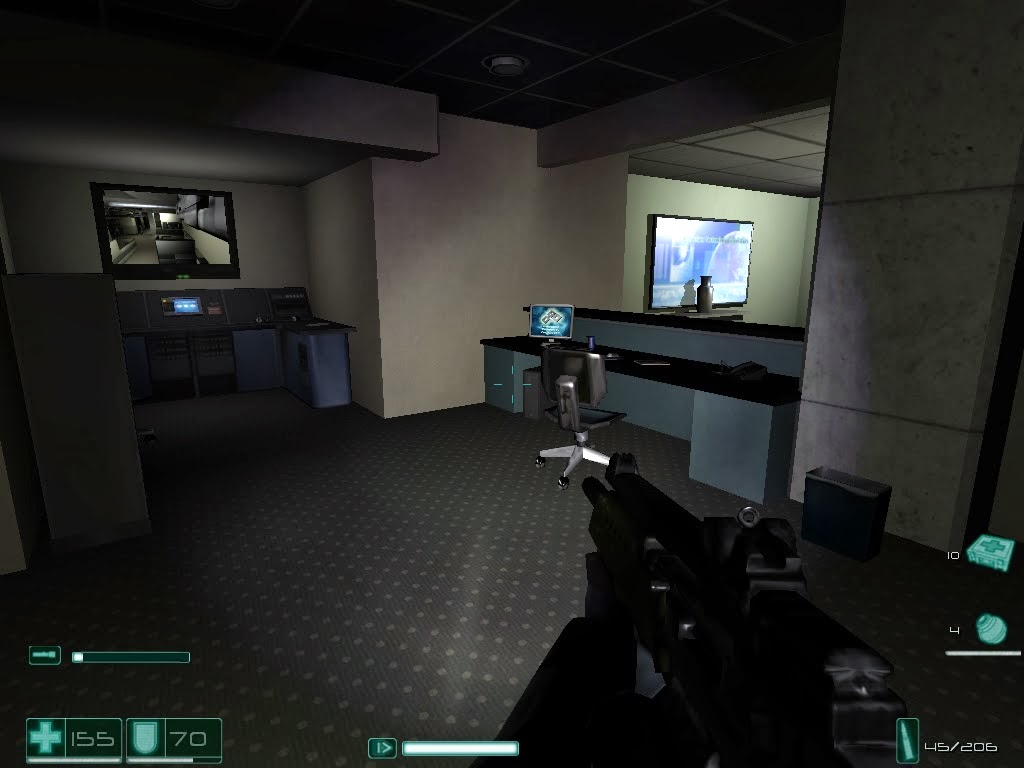
F.E.A.R. was created by Monolith, a developer based in Kirkland, Washington, located not that far from Microsoft's headquarters. Aside from F.E.A.R., Monolith is known for the Condemned games and Gotham City: Imposters as well as the aforementioned Lord of the Rings title. They seem quite fond of acronyms in their game titles, and other examples include Contract J.A.C.K. and No One Lives Forever: A Spy in H.A.R.M.'s Way. F.E.A.R. was released in October 2005, several months after Valve's pioneering Half Life 2. But gameplay-wise, F.E.A.R. is mired in the era of the original Half Life. Unlike the HL games, F.E.A.R. separates the game into distinct "levels" with loading/debriefing screens breaking up the action. The game world is not a unified whole, as it was in Valve's games. You are normally transported to a new area via a cut scene inside a helicopter; a level often ends when you reach the exit door, and then you are dropped off at the entrance of the next level. Most of in-game action consists of exploring halls, tunnels, air ducts, climbing ladders, etc, punctuated by firefights with machine gun wielding enemy soldiers, who yell things like "Squad!" and "Fire in the Hole!" over their intercoms. So it resembles Half Life a great deal in that aspect.
 |
| F.E.A.R.'s exciting environments |
Here's the plot of F.E.A.R.: an experimental psychic super solider and his clone army go rogue, break into some industrial compound and kill everyone there and then go all Hannibal Lector on a dead guy's face. The question is WHY?? That's where you come in. As an agent of "First Encounter Assault Recon," you, the nameless "Point Man" are tasked with tracking the dude down and asking him what the dealio is. Also, you are supposed to take him into custody or something. Obviously, this is easier said than done and the rest of the game is spent chasing the guy all over town. A spooky ghost girl with long, straight, black hair occasionally shows up and makes the lights flicker on and off while your com device gets all staticky. The nameless protagonist doesn't speak in the game, but he's probably pondering the strange coincidence that this is his first day at his new job with an outfit called F.E.A.R., and he finds himself running around in what resembles a horror movie.
 |
| Switch pressin' time! Let's open that gate! |
For most of its length, F.E.A.R. has you running around featureless warehouses, storage rooms, elevator shafts, and various industrial type building. You will encounter many concrete walls and metal shelves which have identical paint cans and plastic containers on them. In the middle of the game you enter an expensive looking office building, and late in the game, a secret science research facility. Aside from shooting people, you will sometimes need to press a button or switch to open a gate or deactivate a security system or something. This all sounds pretty standard, but F.E.A.R. switches it up by tossing in some horror movie tactics from time to time. Aside from the flickering lights/spooky voices, you'll see things get knocked over for no reason, dead bodies dropping out of air vents unexpectedly, pools of blood, and... these weird hallucination sequences. It soon becomes obvious that you, the Point Man, have some connection to the ghost girl and experimental super solider dude (whom the developers named Paxton Fettel, unfortunately.)
 |
| Mysterious blood leaking everywhere |
Thus F.E.A.R. attempts to create an odd sort of FPS/Horror hybrid. The idea is intriguing, but the developers never fully integrate these two genre into a cohesive whole. For one, the spooky stuff and the shooty stuff never happen at the same time. The ghosty girl, Alma, only pulls out the scares when you're walking around the empty parts of a level. Likewise, the shooting-guns-at-enemy-soldiers portions never bear any traces of the supernatural. In fact, knowing Alma is about to appear actually lessens the tension of the game, since you know that as long as the lights are flickering, you aren't going to run into armed bad guys around the next corner. The horror sections are the "safe" part of the game.
 |
| Spooky vision/flashbacks of a mysterious hospital room. |
This disconnect carries over into the game's plot. Despite the fact that this ghost chick keeps popping up and killing people in gruesome ways, (and despite that Paxton Fettel is communicating with you using his psychic powers and dropping hints about the connection between you, Alma and him,) as far as the F.E.A.R team is concerned, all they have on their hands is a rogue super solider. At no point does the silent Point Man open his trap and say "By the way, there's this psychic ghost girl running around and Fettel has some kind of connection to her." Meanwhile, your teammates stand around scratching their heads wondering how the Delta Team got turned into a bloody pile of charred skeletons. The result of this weird disconnect is that F.E.A.R. often feels like you are playing two different games simultaneously.
Aside from the plot being kind of goofy, the action sequences are repetitive. You encounter identical groups of enemy soldiers over and over again, with an occasional heavily armored, extra-tough dude thrown in. At one point there are a bunch of snipers. An mech resembling ED-209 pops up a couple times. But it often feels like you're fighting the same fight over and over. At least Half Life had headcrabs, zombies, and aliens to liven things up. Despite all these issues, F.E.A.R. was very well received when it was released. Metacritic currently lists it at 88. It was considered to be a top-tier game at the time. Even the nerdier gaming sites loved it. Why? Well, part of the reason has to do with gamers being graphic whores. You see, PC gaming enthusiasts get very excited when new, more powerful graphics cards come out and want games that push those cards to the limits. This was perhaps even more true in the early 2000s when developers were busy creating all these fancy new graphics and physics engines. Everything was all about ragdoll physics and realistic lighting effects back then. A story that made sense always took a back seat to how innovative the graphics were.
 |
| The lighting effects are quite nice looking |
F.E.A.R. earned its reputation as a game requiring top of the line hardware to play. In 2005, this game looked AMAZING. It still looks halfway decent today. It had crazy realtime lighting that casts shadows everywhere. The main gameplay gimmick is a Max Payne "bullet time" style slow-mo effect. The slow-mo is a bit more than a mere piece of window dressing; it's pretty vital to not getting killed. It allows you to turn a corner, activate the slow-mo, then draw a bead on enemies and pop off a few shots before they can react. F.E.A.R. puts a cool blur effect on everything while this is happening. This allows the impressive-for-the-time particle effects to shine. When guns are fired, you can see individual bullets flying through the air. Showers of sparks. Windows break and pieces of glass fill the air. Dust obscures your vision. Bullets leave persistent holes in walls. All these fancy particle effects were considered a huge deal at the time, but they weren't supposed to be mere graphical frippery. This was about creating an environment. About making the game world more interactive, more solid, and real. All these GPU-straining effects were intended to create immersion. The graphic effects, in some sense, were the gameplay.
 |
| The blurry slow-mo battles look cool. |
It also benefited from having remarkable solid enemy AI for the time. F.E.A.R. was quite a challenging game. A single, well placed shotgun blast could kill you, so you couldn't just run into a room shooting blindly. Even today, F.E.A.R. is still reasonably fun to play, though it can be a bit tiring.
 |
| Dust and debris goes flying everywhere. |
One thing that struck me about the game is the oddly anti-climatic final act. F.E.A.R. is not very effective about resolving its various plot threads. For much of the second half of the game you are tasked with finding Alice Wade, the daughter of Harlan Wade, one of the creators behind the Origin Project, the top-secret experiment which started the whole mess. About halfway through F.E.A.R. you are told to rescue Alice and escort to her to safety. She manages to slip away and head off to find her father. From this point on, your official mission is to find and rescue Alice and Harlan, as well as capture Fettel. This eventually takes you to the Project Origin site, an underground facility called The Vault, where Alma is kept in a kind of cryogenic coma. Turns out she has super duper psychic powers and is so dangerous she must be kept on ice. And, yes, this is exactly the plot of Akira.
 |
| Alma, when she does appear, is pretty creepy. |
You encounter stiff resistance as you attempt to enter the Vault; once inside you mostly face more hallucinations and spectral appearances from Alma. Despite having been chasing after Alice Wade for half the game, she's dispatched rather casually: you just happen to walk by her dead body in one room. Harlan Wade gets killed in by Alma as you watch passively from the other side of a window. Paxton Fettel gets shot by you in a hallucination/flashback cutscene thing. Quite frankly, I forgot what happened to Fettel until I read a plot synopsis online while writing this article. It's hard to think of another game of this era that kills off its cast and wraps any loose plot threads in such a dismissive fashion. The last two sections of the game barely contain any enemies, other than these phantoms which rush you and can easily be blown away with a single shot. Compared to the pitched firefights throughout the rest of the game, these enemy encounters are quite lame. If you were expecting a boss fight or some kind of big showdown... well, it just never happens. You leave the vault, wander through an abandoned building, find the exit, which leads an alley outside, and... the game ends. There's a brief cutscene. When the screen then displays "epilogue," it's almost startling. You almost want to jump up and shout "What!? That was it?"
 |
| This is Fettel doing something important. I think. I actually can't remember. |
Looking back now, I almost admire the unexpected ending and the sudden jolt at the very end. It's dumb and clichéd, but it stands in stark contrast to the drawn out cutscenes we get today. For your pleasure, I've recorded and uploaded it. (Spoiler alert, obviously.)
When the rumbling starts and the dust cloud starts rolling down the street, you assume some serious shit is going to happen. An epic boss battle or something. But nope, nada. Sitting through the entire credits will get you a brief voiceover which was intended to set up the sequel. Still, it's a bizarre and action-free final act for an action-packed game.
I'll admit, one of my favorite parts of F.E.A.R. is this guy, an obese, junk food munching sysadmin guy. He's the only lighthearted thing in an otherwise entirely grim game. He appears at various points in the game to annoy you (he even tries to kill you at some point) and his appearances are always marked by his rather goofy musical leitmotif forcing its way into the soundtrack. In his review, Ray Hardgrit expresses his dislike for the character and feels he clashes with the rest of F.E.A.R.'s tone. In my opinion, I like that the developers had some confidence in their ability to modulate F.E.A.R.'s mood by inserting a bit of comic relief into their horror game. You need something a bit silly to make the horrible parts seem even more horrible. (Check out that Shakespeare guy for some examples.)
 |
| He eventually gets what's coming to him. |
As an action game, F.E.A.R. mostly delivers. As a psychological horror game, it kinda delivers, but ultimately fails. You can't experience any kind of emotional attachment to the game's cardboard characters. And the game almost completely falls apart in the final act. It's an impressive achievement in many ways, I just wish it was a little bit better. With a few tweaks, it could have been great.
Subscribe to:
Posts (Atom)