Tuesday, January 31, 2017
A Personal Note
The Chrontendo Blog is rarely updated nowadays. I think most people check Twitter or Youtube for updates instead. It's been a difficult week for me. We lost our dog Molly on Saturday, and I felt the need to say more about it than I could in a series of Tweets.
Molly was not a young dog; she was 13. However, the suddenness of her passing was shocking. Prior to last weekend she appeared to be in excellent shape. The Friday before last we noticed her walking a little stiffly and acting lethargic. We also found a swelling in her ear, which concerned us. I thought she may have been bitten by a spider or was suffering from an infection. We took her to the vet on Sunday, where we learned the swelling in the ear was not serious or uncommon by itself. However the doctor wanted to run some blood tests to find out what was causing her lack of energy.
On Tuesday we got the results of the blood tests, which showed Molly had a low red blood cell count. The doctor suggested that an ultrasound be done to look for abnormalities in her organs. I took her in for the ultrasound on Wednesday, and at this point, I was not terribly worried. I'd had anemia myself at one point and it just required me to take iron supplements.
Wednesday afternoon the doctor called me back with bad news. Molly's ultrasound showed cancerous tumors on her liver and spleen. The low red cell count was due to internal blood loss. There was nothing that could be done to save her. I asked the vet how much time she had, and he replied that she might not even last through the night. Probably a week at most. Molly seemed tired but comfortable on Thursday and Friday. By Saturday, she was showing signs of distress, so we took her into the vet to be put to sleep. Again -- the thing that shocked us the most was how sudden this all happened. Molly hadn't been displaying any signs of bad health and was in remarkably good shape for her age. She was stronger and more energetic than our other dog, Gigi, who is also 13, and we always assumed that Molly would outlive Gigi. I am still having difficulty processing the fact that Molly is no longer with us.
Her death hit both of us pretty hard. This was the first time in our adult lives that either of us had to deal with the loss of a dog. We got Gigi a few years after we bought our house and Molly followed a little later. After all these years of having Molly here with us, it's hard to wake up and realize she's no longer with us. We've had pet cats die since we've been living together, and while I don't mean to diminish the loss cat owners feel, having a dog die was much more difficult.
Molly really was one of the greatest dogs I have ever known. She almost certainly saved two people's lives. My mother found her in an animal shelter, two days before she was scheduled to be killed. She was around 6 months old and appeared to have been abused. She was terrified of me at first; in fact she was terrified of any man. If I approached her with my hand in the air, she would cringe. It required a lot of work and patience, but eventually Molly became a fearless, devoted and loving dog. She was incredibly protective. I don't doubt for a minute that would have given her life to protect me or my wife from harm.
My mother would not be alive today if weren't for Molly. Around a decade ago, Molly began sniffing at my mother's chest obsessively and making whimpering or growling noises. She did this consistently until my mother got concerned and went to her doctor for a checkup. Testing revealed she had stage 4 breast cancer. The cancer had spread enough that my mother's doctor didn't give her good odds of surviving. She made it through surgery and chemotherapy, but if she had found out about the cancer later, it would have been too late. Incredibly, Molly detected breast cancer in another woman a couple years later, who, again, was able to get treatment in time.
I worry a lot about Gigi, and how she'll handle Molly no longer being here. Gigi is pretty old herself and I know she misses Molly. There are times when she appears to be walking around the house looking for her. Sometimes I instinctively glance at a dog bed to see if Molly is lying down in it. I've gotten so accustomed to seeing her every day it's hard to accept she's gone. She gave so much of herself to us, I feel like I've betrayed her by not being able to save her. I know we'll eventually accept Molly's death, but for the moment, we are missing her greatly.
My apologies for this depressing post, and thanks for hearing me out. I'll update the blog again shortly when Chrontendo Episode 51 is ready, which should be in the near future.
Saturday, September 10, 2016
Extremely Delayed Update
You might be tempted to think I've abandoned this blog. Yet here I am with a new post. A couple things happened since the last post. Obviously Chrontendo Episode 49 was released.
And now, Chrontendo Episode 50 is also out! As always you can stream it on Youtube in high-ish def ad 60 fps, or you can download it on Archive. There are a few video options.
The purest, least processed version is the 480p AVI file here.
There is a also a large 720p mkv version here.
And a smaller 720p mkv here.
There is are also mp4 versions of the about two files. You can see all the downloads here, but avoid any version not mentioned above.
Chrontendo Episode 50 has one of the worst selection of games of any episode so far. A couple decent titles, Softball Tengoku and Super Spike V'Ball turn up, but the remainder is mostly crap from the likes of Beam, Rare, Tose and the like.
To fill out this episode with something worthwhile, I included the 1989 computer game roundup. A look at some of the highlights (and a few lowlights, like the amazing David Wolf: Secret Agent), the round up takes a good 30 minutes of Episode 50's run time. The most well known computer games from 89 would be Sim City, Populous, and Prince of Persia, but there are plenty of lesser known important titles like Catacomb (essentially the 2D blueprint for Doom) and Harpoon (considered to be the greatest naval warfare simulation game of all time). The overall narrative of the history of computer gaming in the late 80s and early 90 is: a) the triumph of the DOS based PC over its competitors and b) the ever increasing graphical powers of PCs, when led to the transition from 2D games to 3D games. We see a number of early, almost forgotten 3D games in this episode, including Interphase and Archipelagos.
The highlights of Episode 50 are two reasonably fun/competent sports games Softball Tengoku and Super Spike V'Ball. Softball Tengoku, perhaps the first all-furry baseball videogame, is a crudely made yet creative and fun game featuring a bizarre roster of animal and monster players. It was made significantly less weird for the US market and released as Dusty Diamond's All-Star Softball. Technos Japan's Super Spike V'Ball is a less creative, though sturdily designed volleyball game.
On the lower end of the spectrum we have... well, almost everything else. The Three Stooges is a port of the Cinemaware Amiga game and my least favorite game this episode. A hastily slapped together collection of bad minigames, the Amiga version at least had nice sound and graphics. The NES port, developed by Beam (seen last episode with their Back to the Future) is a ugly unpleasant mess.
Episode 50 breaks the baseball game record with four baseball games total. Aside from Softball Tengoku we have:
Kattobi! Warabe Ko
This is a rather odd card-based game taken from a manga. Published by Pack-in-Video.
Choujin Ultra Baseball/Baseball Simulator 1.000
Similar to Softball Tengoku, this Culture Brain title features players with superhuman baseball abilities. Too bad they released under the incredibly boring and inappropriate name Baseball Simulator 1.000 in the US.
Major League
Yes, a Japan only game based on Major League, the movie with Charlie Sheen. Sadly, after the opening scenes, it's a totally generic baseball game.
Tose developed Softball Tengoku, and they were responsible for two other games this episode:
Tashiro Masashi no Princess ga Ippai
Fan translated under the absurd title Princesstual Orgy, this action platformer stars the (now disgraced) comedian Tashiro Masashi. A relatively nice looking game from Tose, it's absolutely sunk by the horrible slippery controls and terrible level design. A shame since I was looking forward to this one based in it's loony title.
Dragon Ball 3: Gokuuden
Tose games are actually getting pretty slick at times. An RPG/card game/board game based on the manga and anime. A little prettier than the last Dragon Ball game.
Rounding out the detritus:
Dungeon Magic
Published by Natsume in Japan and by Taito in the US, this is one of few Japanese developed games that attempts to imitate the Bard's Tale style of western RPG. The results are shockingly ugly, but it turns out this game has its fans.
Jeopardy Jr Edition/Wheel of Fortune Jr Edition
Two very slightly revised versions of these Rare/Game Tek titles from 1988. Rare just went in, slightly altered some graphics and replaced the questions/puzzles with easier ones aimed at younger kids.
Stealth ATF
Cashing in on the interest surrounding the recently unveiled stealth fighter, this gem from Activision/Imagineering feels like the lost cousin of Top Gun, right down to a plane that's impossible to land without crashing.
Gozonji Yaji Kita Chindochū
Yet another humorous menu based adventure game, this time from HAL.
Twin Eagle
One of the rare instances where a game is released in the US first, then much later in Japan. The original arcade game was not particularly notable. This NES port is notable for being one of the worst shoot-em-ups on the system.
Mahjong Taikai
Of course there's a mahjong game. This is published by Koei, strangely enough. It's a port of a computer game in which famous historical figures face off in a game of mahjong.
Coming soon is a Video Nasties double header! Two episodes back to back featuring Lucio Fulci's The Beyond and The House by the Cemetery.
After that, Episode 51 will finally take us to December 1989! Highlights include Square's Tom Sawyer and an almost forgotten game published by Nintendo.
And now, Chrontendo Episode 50 is also out! As always you can stream it on Youtube in high-ish def ad 60 fps, or you can download it on Archive. There are a few video options.
The purest, least processed version is the 480p AVI file here.
There is a also a large 720p mkv version here.
And a smaller 720p mkv here.
There is are also mp4 versions of the about two files. You can see all the downloads here, but avoid any version not mentioned above.
Chrontendo Episode 50 has one of the worst selection of games of any episode so far. A couple decent titles, Softball Tengoku and Super Spike V'Ball turn up, but the remainder is mostly crap from the likes of Beam, Rare, Tose and the like.
To fill out this episode with something worthwhile, I included the 1989 computer game roundup. A look at some of the highlights (and a few lowlights, like the amazing David Wolf: Secret Agent), the round up takes a good 30 minutes of Episode 50's run time. The most well known computer games from 89 would be Sim City, Populous, and Prince of Persia, but there are plenty of lesser known important titles like Catacomb (essentially the 2D blueprint for Doom) and Harpoon (considered to be the greatest naval warfare simulation game of all time). The overall narrative of the history of computer gaming in the late 80s and early 90 is: a) the triumph of the DOS based PC over its competitors and b) the ever increasing graphical powers of PCs, when led to the transition from 2D games to 3D games. We see a number of early, almost forgotten 3D games in this episode, including Interphase and Archipelagos.
The highlights of Episode 50 are two reasonably fun/competent sports games Softball Tengoku and Super Spike V'Ball. Softball Tengoku, perhaps the first all-furry baseball videogame, is a crudely made yet creative and fun game featuring a bizarre roster of animal and monster players. It was made significantly less weird for the US market and released as Dusty Diamond's All-Star Softball. Technos Japan's Super Spike V'Ball is a less creative, though sturdily designed volleyball game.
On the lower end of the spectrum we have... well, almost everything else. The Three Stooges is a port of the Cinemaware Amiga game and my least favorite game this episode. A hastily slapped together collection of bad minigames, the Amiga version at least had nice sound and graphics. The NES port, developed by Beam (seen last episode with their Back to the Future) is a ugly unpleasant mess.
Episode 50 breaks the baseball game record with four baseball games total. Aside from Softball Tengoku we have:
Kattobi! Warabe Ko
This is a rather odd card-based game taken from a manga. Published by Pack-in-Video.
Choujin Ultra Baseball/Baseball Simulator 1.000
Similar to Softball Tengoku, this Culture Brain title features players with superhuman baseball abilities. Too bad they released under the incredibly boring and inappropriate name Baseball Simulator 1.000 in the US.
Major League
Yes, a Japan only game based on Major League, the movie with Charlie Sheen. Sadly, after the opening scenes, it's a totally generic baseball game.
Tose developed Softball Tengoku, and they were responsible for two other games this episode:
Tashiro Masashi no Princess ga Ippai
Fan translated under the absurd title Princesstual Orgy, this action platformer stars the (now disgraced) comedian Tashiro Masashi. A relatively nice looking game from Tose, it's absolutely sunk by the horrible slippery controls and terrible level design. A shame since I was looking forward to this one based in it's loony title.
Dragon Ball 3: Gokuuden
Tose games are actually getting pretty slick at times. An RPG/card game/board game based on the manga and anime. A little prettier than the last Dragon Ball game.
Rounding out the detritus:
Dungeon Magic
Published by Natsume in Japan and by Taito in the US, this is one of few Japanese developed games that attempts to imitate the Bard's Tale style of western RPG. The results are shockingly ugly, but it turns out this game has its fans.
Jeopardy Jr Edition/Wheel of Fortune Jr Edition
Two very slightly revised versions of these Rare/Game Tek titles from 1988. Rare just went in, slightly altered some graphics and replaced the questions/puzzles with easier ones aimed at younger kids.
Stealth ATF
Cashing in on the interest surrounding the recently unveiled stealth fighter, this gem from Activision/Imagineering feels like the lost cousin of Top Gun, right down to a plane that's impossible to land without crashing.
Gozonji Yaji Kita Chindochū
Yet another humorous menu based adventure game, this time from HAL.
Twin Eagle
One of the rare instances where a game is released in the US first, then much later in Japan. The original arcade game was not particularly notable. This NES port is notable for being one of the worst shoot-em-ups on the system.
Mahjong Taikai
Of course there's a mahjong game. This is published by Koei, strangely enough. It's a port of a computer game in which famous historical figures face off in a game of mahjong.
Coming soon is a Video Nasties double header! Two episodes back to back featuring Lucio Fulci's The Beyond and The House by the Cemetery.
After that, Episode 51 will finally take us to December 1989! Highlights include Square's Tom Sawyer and an almost forgotten game published by Nintendo.
Friday, January 22, 2016
Video Nasties Episode 3!
Seems like I hardly ever update this damn blog anymore, but here's the latest scoop.
The newest video on the Dr. Sparkle After Dark channel has been posted. In response to Wes Craven's death, I decided to cover 1972's Last House on the Left, which was produced by Sean Cunningham and written/directed by Craven. Aside from the 1080p Youtube version, you can find downloadable versions on Archive in 1080p, 720p, and a smaller sized 720p formats.
Aside from discussing the film itself, I go into a bit of professional history of some of the cast and crew. Craven's work in the porn industry is somewhat well known, though little discussed. Additionally, several members of the cast, namely Sandra Cassel & Lucy Grantham, who played Mari & Phylis, as well as Fred Lincoln (Weasel) and 'Gaylord St James' (Dr Collingwood), had history in the sex movie industry. Lincoln, in particular, was an extremely prolific actor and director, who worked in the porn biz until two years before his death in 2013. He was also the co-owner of the notorious NYC swinger's club Plato's Retreat. (Richard Dreyfuss was a regular there. Jeramie Rain, who played Sadie in Last House, married Dreyfuss a few years after Plato's Retreat opened. Coincidence?)
One way to look at Last House is that it is a porn movie without hardcore sex. It was originally planned to be a sexually explicit film. This element was dropped in pre-production, but it does explain the casting of several porn actors. There were also numerous ties, both personal and professional, among the cast and crew. For example, Fred Lincoln and Lucy Grantham were dating at the time; David Hess was dating Martin Kove's sister, and so on.
One thing about Last House that really bothers people is the severe tonal shifts throughout the film. Scenes of psychological torture and violence are intercut with the goofy antics of the local sheriff and deputy. The music (by David Hess) appears to be wildly inappropriate at times. The killers' theme song is a rollicking bluegrass-y number that refers to Krug, Sadie, etc as a "quartet in harmony/barbershop band" and describes the film's murders and rapes as a fun little afternoon outing.
The first time I saw Last House, the silly humor and inappropriate music struck me was being very strange. Having seen it a couple more times over the years, and then scouring every inch of the film while editing the video, I realize these elements are essential to Last House's artistic success. The lighthearted moments not only keep Last House from being 90 minutes of unrelenting bleakness, but also provide enough contrast to make brutal moments feel that much more brutal.
The use of irony, especially in the soundtrack, acts as a distancing technique. Craven must have picked this up from studying Europeans films such as those by Bergman. Watching it now, I can see its art film roots much more clearly than I could when I was younger. For a debut film, Last House on the Left is surprisingly sophisticated.
Next up is Chrontendo 49, which will cover a bunch of crap along the lines of LJN's Back to the Future and Who Framed Roger Rabbit. A pretty rough episode, for the most part, considering it also has a Hokuto no Ken RPG and another Japan-only adventure game from Nintendo.
When The Video Nasties return, it will cover the bizarre 1980 horror movie The Frozen Scream, which was recently released in a pretty watchable edition, taken from the original negative, for the first time.
The newest video on the Dr. Sparkle After Dark channel has been posted. In response to Wes Craven's death, I decided to cover 1972's Last House on the Left, which was produced by Sean Cunningham and written/directed by Craven. Aside from the 1080p Youtube version, you can find downloadable versions on Archive in 1080p, 720p, and a smaller sized 720p formats.
Aside from discussing the film itself, I go into a bit of professional history of some of the cast and crew. Craven's work in the porn industry is somewhat well known, though little discussed. Additionally, several members of the cast, namely Sandra Cassel & Lucy Grantham, who played Mari & Phylis, as well as Fred Lincoln (Weasel) and 'Gaylord St James' (Dr Collingwood), had history in the sex movie industry. Lincoln, in particular, was an extremely prolific actor and director, who worked in the porn biz until two years before his death in 2013. He was also the co-owner of the notorious NYC swinger's club Plato's Retreat. (Richard Dreyfuss was a regular there. Jeramie Rain, who played Sadie in Last House, married Dreyfuss a few years after Plato's Retreat opened. Coincidence?)
One way to look at Last House is that it is a porn movie without hardcore sex. It was originally planned to be a sexually explicit film. This element was dropped in pre-production, but it does explain the casting of several porn actors. There were also numerous ties, both personal and professional, among the cast and crew. For example, Fred Lincoln and Lucy Grantham were dating at the time; David Hess was dating Martin Kove's sister, and so on.
One thing about Last House that really bothers people is the severe tonal shifts throughout the film. Scenes of psychological torture and violence are intercut with the goofy antics of the local sheriff and deputy. The music (by David Hess) appears to be wildly inappropriate at times. The killers' theme song is a rollicking bluegrass-y number that refers to Krug, Sadie, etc as a "quartet in harmony/barbershop band" and describes the film's murders and rapes as a fun little afternoon outing.
The first time I saw Last House, the silly humor and inappropriate music struck me was being very strange. Having seen it a couple more times over the years, and then scouring every inch of the film while editing the video, I realize these elements are essential to Last House's artistic success. The lighthearted moments not only keep Last House from being 90 minutes of unrelenting bleakness, but also provide enough contrast to make brutal moments feel that much more brutal.
The use of irony, especially in the soundtrack, acts as a distancing technique. Craven must have picked this up from studying Europeans films such as those by Bergman. Watching it now, I can see its art film roots much more clearly than I could when I was younger. For a debut film, Last House on the Left is surprisingly sophisticated.
Next up is Chrontendo 49, which will cover a bunch of crap along the lines of LJN's Back to the Future and Who Framed Roger Rabbit. A pretty rough episode, for the most part, considering it also has a Hokuto no Ken RPG and another Japan-only adventure game from Nintendo.
When The Video Nasties return, it will cover the bizarre 1980 horror movie The Frozen Scream, which was recently released in a pretty watchable edition, taken from the original negative, for the first time.
Wednesday, November 11, 2015
Here It Is: Chronturbo 5
As many of you have already noticed, the new Chronturbo is now up on Youtube and Archive. Youtube now has the ability to stream 60 fps for 720p videos, though if you want to download the original, not-reprocessed-by-Youtube, file, then Archive is still the place to go.
We have a big fat three CD-ROM games this time: two arcade ports and one original title from the folks who gave us Valis II. As I mentioned earlier, Super Albatross, despite being a golf game, has a lot of similarities to Valis II. The other two CD games are Wonder Boy III: Monster Lair, which is pretty straightforward port of the arcade game, and Juuouki AKA Altered Beast. This port of Altered Beast is pretty terrible -- the graphics are ugly and it controls are sluggish. However Hudson did add a semi-animated intro with sound and music. By semi-animated I mean that it simply uses pans and zooms of static artwork.
Tacking on a PC-Engine exclusive intro onto a port would be a pretty common tactic throughout the console's lifespan. The unusual thing about the PC-Engine Altered Beast is that it was released on both CD-ROM and HuCard a week apart. The two versions are almost identical, except for the HuCard missing the intro and some voice/music samples. Off the top of my head, I can't think of another game that got released in both formats simultaneously.
We have several arcade ports this time, of games originally from Capcom, Namco, Jaleco and Data East. Side Arms and Ordyne are both horizontal shoot-em-ups. Bloody Wolf, probably the best game this episode, is a radically altered version of Data East's Mercs clone. F-1 Dream is an archaic-looking racing game which has been altered quite a bit as well. The biggest weaknesses of Side Arms and Bloody Wolf is that, despite having been originally designed for two players, only a single player mode is available on the PC Engine ports. Takeda Shingen is not the same game as Shingen the Ruler for the FC/NES, but is a horribly botched port of a beat-em-up from Jaleco.
The rest are all original titles, most of which aren't very good. The most offensively terrible is Rock On, a bizarre and amateurishly made horizontal shooter from Big Club/Manjyudo. The last game we saw from these guys which a weird Space Harrier clone. Aside from being extremely dull, stealing one boss directly from R-Type, and having waaayy too many power-ups floating around, Rock On is notable for its utterly insane Engrish-y opening text scroll.
Deep Dungeons
Boring, pointless dungeon crawler. Only of interest to those to love to draw huge maps on graph paper. Excellent graphics/animation of moving through the dungeon, however.
Power League II
Sequel to Power League/World Class Baseball. Neither this nor any of the other Power League sequels got a US release. Standard baseball game.
Break In
This is actually a good billiards game with lots of game options, modes, etc. It's from Naxat, so the graphics and music are pretty darned solid.
Maison Ikokku
A port of a MSX/FM7 adventure game based on the popular Rumiko Takahashi manga. We encountered the Famicom version in an earlier episode of Chrontendo. Luckily the PC Engine port has a quality English translation available, so if you're interested in adventure games for this console, this is one of the very few English options.
Super Momotaro Dentetsu
A big game in Japan, I'm sure. Hudson moves it's popular railway board game to the PC Engine for the second entry in the series. Though in 2015 Nintendo got the last laugh, as it appears future entries the series will be published by them, due to the collapse of Konami.
Artist Tool
Not a real game, but instead an extremely basic drawing program. Three hardware accessories were available - a drawing tablet/stylus, a printer, and a scanner of some sort. The game and the accessories are somewhat rare and expensive now.
We are going to switch over to the Famicom/NES next, but when we do return to the PC Engine, we'll reach up to early December 1989, and get to see some mahjong games, a golf game, and one of the ever-popular business simulation games.
In the very near future, though, we'll have a small update to the Video Nasties series on the Dr. Sparkle After Dark channel.
We have a big fat three CD-ROM games this time: two arcade ports and one original title from the folks who gave us Valis II. As I mentioned earlier, Super Albatross, despite being a golf game, has a lot of similarities to Valis II. The other two CD games are Wonder Boy III: Monster Lair, which is pretty straightforward port of the arcade game, and Juuouki AKA Altered Beast. This port of Altered Beast is pretty terrible -- the graphics are ugly and it controls are sluggish. However Hudson did add a semi-animated intro with sound and music. By semi-animated I mean that it simply uses pans and zooms of static artwork.
![]() |
| Wonder Boy |
Tacking on a PC-Engine exclusive intro onto a port would be a pretty common tactic throughout the console's lifespan. The unusual thing about the PC-Engine Altered Beast is that it was released on both CD-ROM and HuCard a week apart. The two versions are almost identical, except for the HuCard missing the intro and some voice/music samples. Off the top of my head, I can't think of another game that got released in both formats simultaneously.
![]() |
| Side Arms |
We have several arcade ports this time, of games originally from Capcom, Namco, Jaleco and Data East. Side Arms and Ordyne are both horizontal shoot-em-ups. Bloody Wolf, probably the best game this episode, is a radically altered version of Data East's Mercs clone. F-1 Dream is an archaic-looking racing game which has been altered quite a bit as well. The biggest weaknesses of Side Arms and Bloody Wolf is that, despite having been originally designed for two players, only a single player mode is available on the PC Engine ports. Takeda Shingen is not the same game as Shingen the Ruler for the FC/NES, but is a horribly botched port of a beat-em-up from Jaleco.
![]() |
| Rock On |
The rest are all original titles, most of which aren't very good. The most offensively terrible is Rock On, a bizarre and amateurishly made horizontal shooter from Big Club/Manjyudo. The last game we saw from these guys which a weird Space Harrier clone. Aside from being extremely dull, stealing one boss directly from R-Type, and having waaayy too many power-ups floating around, Rock On is notable for its utterly insane Engrish-y opening text scroll.
Deep Dungeons
Boring, pointless dungeon crawler. Only of interest to those to love to draw huge maps on graph paper. Excellent graphics/animation of moving through the dungeon, however.
![]() |
| Power League II |
Power League II
Sequel to Power League/World Class Baseball. Neither this nor any of the other Power League sequels got a US release. Standard baseball game.
Break In
This is actually a good billiards game with lots of game options, modes, etc. It's from Naxat, so the graphics and music are pretty darned solid.
Maison Ikokku
A port of a MSX/FM7 adventure game based on the popular Rumiko Takahashi manga. We encountered the Famicom version in an earlier episode of Chrontendo. Luckily the PC Engine port has a quality English translation available, so if you're interested in adventure games for this console, this is one of the very few English options.
![]() |
| Momotaro Dentetsu |
Super Momotaro Dentetsu
A big game in Japan, I'm sure. Hudson moves it's popular railway board game to the PC Engine for the second entry in the series. Though in 2015 Nintendo got the last laugh, as it appears future entries the series will be published by them, due to the collapse of Konami.
Artist Tool
Not a real game, but instead an extremely basic drawing program. Three hardware accessories were available - a drawing tablet/stylus, a printer, and a scanner of some sort. The game and the accessories are somewhat rare and expensive now.
We are going to switch over to the Famicom/NES next, but when we do return to the PC Engine, we'll reach up to early December 1989, and get to see some mahjong games, a golf game, and one of the ever-popular business simulation games.
In the very near future, though, we'll have a small update to the Video Nasties series on the Dr. Sparkle After Dark channel.
Monday, August 10, 2015
Coming Soon: Chronturbo 5
One bizarre game to be featured in Chronturbo 5 is Super Albatross. This is one of three CD-ROM² games this episode. The odd thing is that Super Albatross is a golf game, which seems like a strange choice for the CD format. Golf games of the era aren't normally full of visual flair. However, Super Albatross was created Telenet/Lasersoft, the same folks who did Valis II for the PC Engine. The developers chose to insert absurd Valis-style cutscenes between levels.
These anime-like cutscenes almost make Super Albatross seem like a parody of Valis II. The protagonist must win a number of rounds of golf against a series of goofy opponents. Each opponent in introduced in a dramatic cutscene and their stats -- height, weight, and power -- are provided, just like in Valis II's boss battles.
These animated cutscenes are done in the exact same style as those in Valis II, right down the same shade of green being used as the background. Unfortunately, the actual golfing part of Super Albatross is pretty lame, even by 1989 standards.
Chronturbo 5 has been almost completely recorded and will go into editing soon. Not sure of an exact date, but keep an eye peeled.
In the meantime, I've uploaded the second episode of the Video Nasties series. This one covers a well loved slasher film, The Burning. This movie is unusual in a few ways. It ended up on the nasties list due an error -- the label accidentally released the tape with the non-BBFC approved version. Also, there is a surprising amount of award-winning talent in this movie. Aside the various future Oscar, Emmy and Tony award winners who were involved, The Burning was produced by Bob and Harvey Weinstein (their first film production, in fact). Brad Grey, who is now the CEO of Paramount, was also involved to some extent.
Unlike some of the nasties, quite a bit of information is available on the background and production of the film, so I got into this in a bit detail. Compared to Driller Killer, not too much psychological or artistic analysis is possible, since this was a completely mercenary project. Even the director admits to not having seen the movie since it was released. The main consideration seemed to be creating an movie with sufficient blood and nudity to keep the audience interested.
As always you can check this thing out on Youtube, and downloadable versions in various sizes can be found on Archive. Here are the individual files:
1080p 1.9 Gigs
720p 1.3 Gigs
720p (smaller) 713.8 Megs
Check back for another update soon.
These anime-like cutscenes almost make Super Albatross seem like a parody of Valis II. The protagonist must win a number of rounds of golf against a series of goofy opponents. Each opponent in introduced in a dramatic cutscene and their stats -- height, weight, and power -- are provided, just like in Valis II's boss battles.
These animated cutscenes are done in the exact same style as those in Valis II, right down the same shade of green being used as the background. Unfortunately, the actual golfing part of Super Albatross is pretty lame, even by 1989 standards.
Chronturbo 5 has been almost completely recorded and will go into editing soon. Not sure of an exact date, but keep an eye peeled.
In the meantime, I've uploaded the second episode of the Video Nasties series. This one covers a well loved slasher film, The Burning. This movie is unusual in a few ways. It ended up on the nasties list due an error -- the label accidentally released the tape with the non-BBFC approved version. Also, there is a surprising amount of award-winning talent in this movie. Aside the various future Oscar, Emmy and Tony award winners who were involved, The Burning was produced by Bob and Harvey Weinstein (their first film production, in fact). Brad Grey, who is now the CEO of Paramount, was also involved to some extent.
Unlike some of the nasties, quite a bit of information is available on the background and production of the film, so I got into this in a bit detail. Compared to Driller Killer, not too much psychological or artistic analysis is possible, since this was a completely mercenary project. Even the director admits to not having seen the movie since it was released. The main consideration seemed to be creating an movie with sufficient blood and nudity to keep the audience interested.
As always you can check this thing out on Youtube, and downloadable versions in various sizes can be found on Archive. Here are the individual files:
1080p 1.9 Gigs
720p 1.3 Gigs
720p (smaller) 713.8 Megs
Check back for another update soon.
Wednesday, July 22, 2015
Some News for You
My goodness! Has it really been this long since I've updated this blog? My apologies.
If you're wondering what's currently on the plate for Dr. Sparkle, I'm currently waist-deep in Chronturbo Episode Five, covering July through September 1989. Compared to last episode, which featured Valis II, Blazing Lazers and the ambitious CD-ROM RPG Tengai Makyou: Ziria, Episode Five is kind of lame. We've got a handful of arcade ports, the usual golf and baseball games, one adventure game, and some random junk.
One rather bizarre PC Engine release is NEC's port of Altered Beast, or more properly, Juuouki, since this version didn't come out stateside. There were a few Sega games ported to the PC Engine (and the Famicom!) but Altered Beast has been released not that long ago on the Mega Drive, and was considered of sufficient quality to become the pack-in title for the Genesis. I don't know exactly what Sega's reasoning was for licensing the game to NEC. Perhaps the popularity of the PC Engine meant it would sell more copies than it would on the Mega Drive.
Even stranger though, was the way Altered Beast was released. It is the only PC Engine game I know of (off the top of my head) that received near-simultaneous releases on the HuCard and CD-ROM. On September 22, 1989 the CD-ROM version hit the shelves; then the card version came out a week later. The differences between the two are minimal. The CD version has an brief narrated intro that is accessible from the main menu. Unlike Valis II, this is not an animated style intro, but rather ugly looking still images with narration and music. In addition, the CD version has speech samples which are missing from the HuCard version. Aside from that, the game itself is identical.
I'm not really sure why NEC released this on CD-ROM, other than to give early adaptors another game to justify their purchase of the peripheral. The CD-ROM² was launched 9 months prior, and only 8 games had been released for it. A bunch of CD-ROM games started coming out around February and March of 1990, so there were clearly a lot of titles in the works. Still, everything about the CD-ROM Altered Beast screams "desperate cash-in." The disc itself if only 94 megabytes, making it the smallest PC Engine disc game I know of.
Two other CD-ROM games will be covered this episode, one of which is Wonder Boy III: Monster Lair. This is the "other" Wonder Boy III: a port of the arcade game, not to be confused with The Dragon's Trap. It's a simple little platformer/shoot-em-up hybrid which has some slammin' music. The other game is Super Albatross, which has an intriguing name but turns out to be merely a golf game. Kusoge fans will be pleased to know there are two pretty terrible HuCard games this episode as well.
Also, I'll mention this stupid thing I'm doing during my spare time (ie: while I'm on the clock at work), the Day by Day blog. For the innocent among you, Day By Day is an extremely ugly, paranoid, sorta white supremacist, MRA comic. It began life 13 years ago and a Republican-leaning Doonesbury clone. It even had limited syndication for a while. The creator's brain kind of snapped when Obama was elected and it just devolved into the awful mess it is today. This blog of mine is a look at Day by Day through the years, watching it turn into horrifying crap.
The current Chrontendo schedule is as follows: Chronturbo 5 is partway done. I've had very little time to work on this stuff for the last few weeks, but hope to pick up the pace soon. Also, Video Nasties Ep. 2 will be out soon (it's actually more or less been sitting in the can for a little while.) There will be a short Video Nasties Ep 2 Part 2 video soon afterwards. Sort of a one-off follow up video.
If you're wondering what's currently on the plate for Dr. Sparkle, I'm currently waist-deep in Chronturbo Episode Five, covering July through September 1989. Compared to last episode, which featured Valis II, Blazing Lazers and the ambitious CD-ROM RPG Tengai Makyou: Ziria, Episode Five is kind of lame. We've got a handful of arcade ports, the usual golf and baseball games, one adventure game, and some random junk.
One rather bizarre PC Engine release is NEC's port of Altered Beast, or more properly, Juuouki, since this version didn't come out stateside. There were a few Sega games ported to the PC Engine (and the Famicom!) but Altered Beast has been released not that long ago on the Mega Drive, and was considered of sufficient quality to become the pack-in title for the Genesis. I don't know exactly what Sega's reasoning was for licensing the game to NEC. Perhaps the popularity of the PC Engine meant it would sell more copies than it would on the Mega Drive.
Even stranger though, was the way Altered Beast was released. It is the only PC Engine game I know of (off the top of my head) that received near-simultaneous releases on the HuCard and CD-ROM. On September 22, 1989 the CD-ROM version hit the shelves; then the card version came out a week later. The differences between the two are minimal. The CD version has an brief narrated intro that is accessible from the main menu. Unlike Valis II, this is not an animated style intro, but rather ugly looking still images with narration and music. In addition, the CD version has speech samples which are missing from the HuCard version. Aside from that, the game itself is identical.
![]() |
| Scene from the CD-ROM intro. |
I'm not really sure why NEC released this on CD-ROM, other than to give early adaptors another game to justify their purchase of the peripheral. The CD-ROM² was launched 9 months prior, and only 8 games had been released for it. A bunch of CD-ROM games started coming out around February and March of 1990, so there were clearly a lot of titles in the works. Still, everything about the CD-ROM Altered Beast screams "desperate cash-in." The disc itself if only 94 megabytes, making it the smallest PC Engine disc game I know of.
![]() |
| PCE Altered Beast looks considerable worse than the Genesis version. |
Two other CD-ROM games will be covered this episode, one of which is Wonder Boy III: Monster Lair. This is the "other" Wonder Boy III: a port of the arcade game, not to be confused with The Dragon's Trap. It's a simple little platformer/shoot-em-up hybrid which has some slammin' music. The other game is Super Albatross, which has an intriguing name but turns out to be merely a golf game. Kusoge fans will be pleased to know there are two pretty terrible HuCard games this episode as well.
![]() |
| Rock On. This game is bullshit. |
Also, I'll mention this stupid thing I'm doing during my spare time (ie: while I'm on the clock at work), the Day by Day blog. For the innocent among you, Day By Day is an extremely ugly, paranoid, sorta white supremacist, MRA comic. It began life 13 years ago and a Republican-leaning Doonesbury clone. It even had limited syndication for a while. The creator's brain kind of snapped when Obama was elected and it just devolved into the awful mess it is today. This blog of mine is a look at Day by Day through the years, watching it turn into horrifying crap.
The current Chrontendo schedule is as follows: Chronturbo 5 is partway done. I've had very little time to work on this stuff for the last few weeks, but hope to pick up the pace soon. Also, Video Nasties Ep. 2 will be out soon (it's actually more or less been sitting in the can for a little while.) There will be a short Video Nasties Ep 2 Part 2 video soon afterwards. Sort of a one-off follow up video.
Tuesday, May 26, 2015
Micro Update!
For those who want/prefer a downloadable/non YouTube-processed version of The Video Nasties Episode 1, 1080p and 720p versions are available on Archive, here:.
Sunday, May 24, 2015
Enter: The Video Nasties
As promised earlier, I've started a new channel, Dr Sparkle After Dark, for uploading non-gaming related content. The first (non-pilot) episode of the Video Nasties series has just been uploaded, and is available for your viewing enjoyment. I suspect an age restriction will end up being placed on this series at some point.
Just as with Chrontendo, episodes will also be posted to Archive.org. In the event that a Nasties video gets pulled from Youtube, it will still be available to view on Archive.
I provide some background information on the video nasties phenomenon in this video's intro, but here's a quick summary: The UK has historically been one of the most censorious nations in the western industrial word, with film censorship being handled by an organization called the BBFC. The BBFC rates films much like the MPAA does in the US, though failure to obtain a BBFC rating usually prohibits a film from being distributed in a normal theatrical setting. When home video formats such as the VHS tape became available in the late 70s/early 80s, there was no sort of regulation or censorship placed on them. A number of foreign sex and horror movies were released in the UK on video, causing an uproar in the tabloids. UK tabloids are notoriously sensationalistic, and labeled such films "video nasties," though the term was first used in The Sunday Times. The theory was that viewing such films would corrupt the unsullied minds of Britain's youth, thus turning them into a generation of degenerates, murderers and criminals.
The authorities stepped in and began seizing tapes from video stores, on the grounds that they were legally 'obscene.' Obscenity was illegal in the UK, but had previously been used only to ban things for sexual content such as hardcore pornography. Now, horror movies on video were being ruled as obscene in the British courts. After a couple years of chaos, Parliament passed the Video Recordings Act in 1984, which put video tape releases under the control of the BBFC. From this point onward, VHS movies not passed by the BBFC were effectively banned in the UK. Most of the films considered to be 'nasties' had no chance of getting passed by the BBFC, or at the very least would require sizable cuts. The original "pre-cert" video tape releases of the nasties films became highly collectible in the UK: in particular, the "DPP 39," a group of 39 movies successfully prosecuted as obscene prior to the VRA.
In addition to those 39 films, there are an additional 33 that the DPP considered obscene but were not successfully prosecuted as such. Also, there were 82 films which were seized and destroyed under civic forfeiture hearings, rather than a criminal trial. We'll cover films from all three categories in this series. As time passed and the BBFC became more lenient, many of the nasties films finally got official DVD/Blu-Ray releases in the UK, though some remain banned in uncut form.
A natural place to start would be Abel Ferrara's The Driller Killer, a 1979 low-budget horror film about a guy that (not surprisingly) kills people with a power drill. It's much closer to a gorier, grittier version of Roman Polanski's Repulsion than a typical slasher movie. The Driller Killer was one of the movies that ignited the original nasties firestorm, but this was more due to the VHS box cover than the film itself. Though the use of a drill as murder weapon was also contentious, since it would easy for people to get their hands on one and re-enact the film's murders.
As for my opinions on Driller Killer, you can watch the video and find out for yourself. In short, I'll say that I liked it. Now, I'm certainly not the first guy on the internet to tackle the nasties. The nasties are in the UK, much like the Famicom library in Japan: everyone's taken a swipe at them. One of the main video reviewers is Glenn Criddle, who has reviewed all of them (I think) under the Youtube handle Lampyman. Here's his take on The Driller Killer:
If anything, Criddle is even more low-key and subdued that I am. He has a pretty different interpretation of it than I do, overlaying a sort of Freudian/Oedipal theme onto the film. I see it more as an economic horror movie, and quite frankly, don't understand why anyone in the 21th century would be engaging in Freudian analysis of movies. Also, while Driller Killer is a gritty little film, I think Criddle overstates the awfulness of the NYC setting in which the protagonist, Reno, lives. The words "squalor" and "slum" pop up in his review, when in fact, NYC in the 70s was a virtual paradise for artistic bohemian types. Reno's Union Square apartment/loft is rather spacious. And while Ferrara plays up NYC's crime and transient population, this ain't exactly Gangs of New York era Five Points.
Here's another Nasty reviewer, doing mini-reviews of Killer and a few others. He's more breezy and animated than Criddle or me, though he doesn't care for the movie much.
Due to the pretty short production time required for these things, (a fraction of the time it takes to make a complete episode of Chrontendo) you might see episodes pretty frequently. And I have other stuff planned for the Dr. Sparkle After Dark channel as well.
Next time will be a much prettier movie, yet still quite gory.
Just as with Chrontendo, episodes will also be posted to Archive.org. In the event that a Nasties video gets pulled from Youtube, it will still be available to view on Archive.
I provide some background information on the video nasties phenomenon in this video's intro, but here's a quick summary: The UK has historically been one of the most censorious nations in the western industrial word, with film censorship being handled by an organization called the BBFC. The BBFC rates films much like the MPAA does in the US, though failure to obtain a BBFC rating usually prohibits a film from being distributed in a normal theatrical setting. When home video formats such as the VHS tape became available in the late 70s/early 80s, there was no sort of regulation or censorship placed on them. A number of foreign sex and horror movies were released in the UK on video, causing an uproar in the tabloids. UK tabloids are notoriously sensationalistic, and labeled such films "video nasties," though the term was first used in The Sunday Times. The theory was that viewing such films would corrupt the unsullied minds of Britain's youth, thus turning them into a generation of degenerates, murderers and criminals.
![]() |
| Typical anti-nastiies headline. |
The authorities stepped in and began seizing tapes from video stores, on the grounds that they were legally 'obscene.' Obscenity was illegal in the UK, but had previously been used only to ban things for sexual content such as hardcore pornography. Now, horror movies on video were being ruled as obscene in the British courts. After a couple years of chaos, Parliament passed the Video Recordings Act in 1984, which put video tape releases under the control of the BBFC. From this point onward, VHS movies not passed by the BBFC were effectively banned in the UK. Most of the films considered to be 'nasties' had no chance of getting passed by the BBFC, or at the very least would require sizable cuts. The original "pre-cert" video tape releases of the nasties films became highly collectible in the UK: in particular, the "DPP 39," a group of 39 movies successfully prosecuted as obscene prior to the VRA.
In addition to those 39 films, there are an additional 33 that the DPP considered obscene but were not successfully prosecuted as such. Also, there were 82 films which were seized and destroyed under civic forfeiture hearings, rather than a criminal trial. We'll cover films from all three categories in this series. As time passed and the BBFC became more lenient, many of the nasties films finally got official DVD/Blu-Ray releases in the UK, though some remain banned in uncut form.
A natural place to start would be Abel Ferrara's The Driller Killer, a 1979 low-budget horror film about a guy that (not surprisingly) kills people with a power drill. It's much closer to a gorier, grittier version of Roman Polanski's Repulsion than a typical slasher movie. The Driller Killer was one of the movies that ignited the original nasties firestorm, but this was more due to the VHS box cover than the film itself. Though the use of a drill as murder weapon was also contentious, since it would easy for people to get their hands on one and re-enact the film's murders.
![]() |
| This cover virtually started the who nasties scare. |
If anything, Criddle is even more low-key and subdued that I am. He has a pretty different interpretation of it than I do, overlaying a sort of Freudian/Oedipal theme onto the film. I see it more as an economic horror movie, and quite frankly, don't understand why anyone in the 21th century would be engaging in Freudian analysis of movies. Also, while Driller Killer is a gritty little film, I think Criddle overstates the awfulness of the NYC setting in which the protagonist, Reno, lives. The words "squalor" and "slum" pop up in his review, when in fact, NYC in the 70s was a virtual paradise for artistic bohemian types. Reno's Union Square apartment/loft is rather spacious. And while Ferrara plays up NYC's crime and transient population, this ain't exactly Gangs of New York era Five Points.
Here's another Nasty reviewer, doing mini-reviews of Killer and a few others. He's more breezy and animated than Criddle or me, though he doesn't care for the movie much.
Due to the pretty short production time required for these things, (a fraction of the time it takes to make a complete episode of Chrontendo) you might see episodes pretty frequently. And I have other stuff planned for the Dr. Sparkle After Dark channel as well.
Next time will be a much prettier movie, yet still quite gory.
Monday, May 4, 2015
The Genesis Arrives
OK folks, cool your heels. The new episode of Chronsega is available for your viewing pleasure. Youtube now offers 60 fps options, you can watch a pretty darn good streaming version there. Or you can download that same file directly from Archive.org. (It's the 1.4 gig MP4 file.) More file sizes/formats will be available there soon.
Chronsega Episode 9 covers July through October 1989 for the Mega Drive/Genesis and "Fall 1989" for those increasingly rare and mysterious Master System games. One very important thing of note this episode is that the Sega Genesis was released in the US on August 14, supposedly only in NYC and Los Angeles at first. Sega of America was in an interesting position at this time. They had only recently retaken over the Master System's distribution and marketing from Tonka. From what I understand, Bruce Lowry, formerly of Nintendo before becoming President of Sega of America in 1986, had quit Sega and gone back to Nintendo in mid-1988, thus leaving SOA headless for a year. Shortly after the Genesis' launch, former Coleco/Atari/Epyx executive Michael Katz stepped in to take charge of Sega's US branch. Katz developed much of what we think about the Genesis when we consider its pre-Sonic era: The focus on celebrity sports figures. The emphasis on the Genesis' superior graphics. The "Genesis Does What Nintendon't" ad campaign.
Katz was replaced after two years by Tom Kalinske. There are two schools of thought re: Katz vs. Kalinske. One is that Katz simply failed to make the Genesis succeed in the US; it was up to Kalinske to turn things around, and that Kalinske's tactics were directly responsible for the Sega's brief US dominance over Nintendo. The other perspective is that many of the seeds of the Genesis' success had already been planted during Katz's reign (for example, Sonic.) Those seeds just happened to bloom after Kalinske took over, thus Kalinske unjustly got all the credit. I suspect the truth lies somewhere in between those two positions.
Sega of America did manage to get quite a few games on the market very quickly. The Genesis launched with five titles, then released another batch in September, then presumably kept new releases coming throughout the rest of the year. It's hard to say for sure what came out when, but this is the second Genesis ad to appear in Game Pro magazine:
This issue must have been on the shelves in Fall 1989, perhaps in November. The same issue mentions Katz' September appointment as Head of Sega of America as breaking news. This at least gives us some idea which titles were available shortly after launch. It gives me the impression that a few titles, such as Golden Axe, Zoom and Revenge of Shinobi were released in the US before Japan.
Soon, Sega would launch it's own Nintendo Power style magazine called Sega Visions, release the Mega Drive in Europe, and eventually find massive success in the US, Europe, Australia an Brazil. For the moment though, we'll look at the second batch of ten games released in Summer and
Fall of 1989. Three games stand out: a port of Sega's arcade hit Golden Axe, a Sega-published port of Capcom's Ghouls 'N Ghosts, and a console original, Revenge of Shinobi.
Golden Axe and Ghouls 'N Ghosts proved once again the system was capable very accurate ports of recent arcade hits, something that was out of the question for the aging NES. Revenge of Shinobi demonstrated what console action platformers could look like in the 16-bit generation. Other new titles this episode aren't as successful. Rambo III is a poor man's Mercs clone, padded with long, maze-like levels to stretch it to console game length. Forgotten Worlds is another Capcom port which isn't nearly as good as Ghouls 'N Ghosts. Super Hang-On is a much improved version of a game that was a launch title for the Master System, with a new career mode added on.
Other titles include Super Hydlide, a port of the computer game Hydlide 3, whose Famicom version we glossed over a few episodes ago. Super Hydlide has some interesting ideas, but its butt-ugly graphics, grindy nature and overall lack of personality will turn off most folks. The music on the Genesis version is fantastic, however. Hokuto no Ken/Last Battle is yet another dull Fist of the North Star beat-em-up, which somehow ended up being a launch title in the US. We've also got a soccer and golf game.
With this episode, we've covered the first 20 Mega Drive/Genesis games released. Here's the breakdown:
7 arcade ports
4 computer ports
9 original games, of which:
3 were action platformers
3 were sports games
1 was a beat-em-up
1 was a top down run-and-gun
1 was an RPG
An interesting and varied assortment of games. As of yet we've only seen two third party publishers, and neither were big names in the videogame market. All this will change in 1990, as the likes of Namco, Taito and EA lend their support to the console.
Until then, head on over to Youtube or Archive and check out Chronsega Episode 9.
Chronsega Episode 9 covers July through October 1989 for the Mega Drive/Genesis and "Fall 1989" for those increasingly rare and mysterious Master System games. One very important thing of note this episode is that the Sega Genesis was released in the US on August 14, supposedly only in NYC and Los Angeles at first. Sega of America was in an interesting position at this time. They had only recently retaken over the Master System's distribution and marketing from Tonka. From what I understand, Bruce Lowry, formerly of Nintendo before becoming President of Sega of America in 1986, had quit Sega and gone back to Nintendo in mid-1988, thus leaving SOA headless for a year. Shortly after the Genesis' launch, former Coleco/Atari/Epyx executive Michael Katz stepped in to take charge of Sega's US branch. Katz developed much of what we think about the Genesis when we consider its pre-Sonic era: The focus on celebrity sports figures. The emphasis on the Genesis' superior graphics. The "Genesis Does What Nintendon't" ad campaign.
Katz was replaced after two years by Tom Kalinske. There are two schools of thought re: Katz vs. Kalinske. One is that Katz simply failed to make the Genesis succeed in the US; it was up to Kalinske to turn things around, and that Kalinske's tactics were directly responsible for the Sega's brief US dominance over Nintendo. The other perspective is that many of the seeds of the Genesis' success had already been planted during Katz's reign (for example, Sonic.) Those seeds just happened to bloom after Kalinske took over, thus Kalinske unjustly got all the credit. I suspect the truth lies somewhere in between those two positions.
Sega of America did manage to get quite a few games on the market very quickly. The Genesis launched with five titles, then released another batch in September, then presumably kept new releases coming throughout the rest of the year. It's hard to say for sure what came out when, but this is the second Genesis ad to appear in Game Pro magazine:
This issue must have been on the shelves in Fall 1989, perhaps in November. The same issue mentions Katz' September appointment as Head of Sega of America as breaking news. This at least gives us some idea which titles were available shortly after launch. It gives me the impression that a few titles, such as Golden Axe, Zoom and Revenge of Shinobi were released in the US before Japan.
Soon, Sega would launch it's own Nintendo Power style magazine called Sega Visions, release the Mega Drive in Europe, and eventually find massive success in the US, Europe, Australia an Brazil. For the moment though, we'll look at the second batch of ten games released in Summer and
Fall of 1989. Three games stand out: a port of Sega's arcade hit Golden Axe, a Sega-published port of Capcom's Ghouls 'N Ghosts, and a console original, Revenge of Shinobi.
Golden Axe and Ghouls 'N Ghosts proved once again the system was capable very accurate ports of recent arcade hits, something that was out of the question for the aging NES. Revenge of Shinobi demonstrated what console action platformers could look like in the 16-bit generation. Other new titles this episode aren't as successful. Rambo III is a poor man's Mercs clone, padded with long, maze-like levels to stretch it to console game length. Forgotten Worlds is another Capcom port which isn't nearly as good as Ghouls 'N Ghosts. Super Hang-On is a much improved version of a game that was a launch title for the Master System, with a new career mode added on.
Other titles include Super Hydlide, a port of the computer game Hydlide 3, whose Famicom version we glossed over a few episodes ago. Super Hydlide has some interesting ideas, but its butt-ugly graphics, grindy nature and overall lack of personality will turn off most folks. The music on the Genesis version is fantastic, however. Hokuto no Ken/Last Battle is yet another dull Fist of the North Star beat-em-up, which somehow ended up being a launch title in the US. We've also got a soccer and golf game.
With this episode, we've covered the first 20 Mega Drive/Genesis games released. Here's the breakdown:
7 arcade ports
4 computer ports
9 original games, of which:
3 were action platformers
3 were sports games
1 was a beat-em-up
1 was a top down run-and-gun
1 was an RPG
An interesting and varied assortment of games. As of yet we've only seen two third party publishers, and neither were big names in the videogame market. All this will change in 1990, as the likes of Namco, Taito and EA lend their support to the console.
Until then, head on over to Youtube or Archive and check out Chronsega Episode 9.
Thursday, April 9, 2015
Youtube Update Video
Not much to see here, just a super quick video update on Youtube letting folks know:
a. Chronsega Ep. 9 is in editing now.
b. There's a new, secondary Chrontendo channel, and an official announcement about the video nasties series (which you guys already knew about.)
Check back soon for the release of Chronsega 9.
a. Chronsega Ep. 9 is in editing now.
b. There's a new, secondary Chrontendo channel, and an official announcement about the video nasties series (which you guys already knew about.)
Check back soon for the release of Chronsega 9.
Thursday, March 19, 2015
"What is this turning into? A goddamned movie blog?"
No, not at all. But watching Star Trek: The Motion Picture led me to check out a few other sci-fi films of the late 70s/early 80s, and I'm writing about one of those today. I've got to justify my monthly expenditure on Netflix somehow. Allow me to briefly draw you attention to the slightly obscure Saturn 3.
![]() |
| The opening shot is once again, big ass spaceship. |
Released in early 1980, a mere three months after ST:TMP, Saturn 3 boasts a ridiculous amount of talent on board; much more talent than you'd need for a low budget film designed to ride on the coattails of Star Wars. The director was Stanley Donen, a true Hollywood legend from the glory days of MGM's Technicolor musicals. His past credits included On the Town, Singing in the Rain, Funny Face and Charade. The principal roles are filled by Kirk Douglas, in one of this last theatrical starring performances; Farrah Fawcett, who was one of the most famous women in the world in 1980; and none other than Harvey Keitel, hot off a series of amazing performances in Taxi Driver, The Duelists and Fingers. On top of this, the script was written by frickin' Martin Amis, who'd achieve literary fame a few years later with his novel Money. Throw in Oscar-winning cinematographer Billy Williams and an Elmer Bernstein score, and you've got one overqualified cast and crew.
Saturn 3 feels like a typical early/mid 70s Hollywood sci-fi movie being forced into a Star Wars-shaped box. The small cast and claustrophobic sets give it a Silent Running* feel. The slightly dystopian theme brings to mind Logan's Run and Soylent Green. The movie is often thought to be influenced by Alien (which it resembles in some ways, but Alien reached theaters only 9 months earlier, and Saturn 3 had been in development since 1975.) The film was conceived by John Barry, a production designer on Clockwork Orange, Phase IV, and Superman. Barry was the original director, but dropped out a couple weeks into filming, leading to Donen, the film's producer, to finish shooting the movie. Barry immediately went on to do second unit directing for The Empire Strikes Back. While working on Empire, he contracted meningitis and suddenly died.
Fawcett got involved when British film mogul Lew Grade, whose company ITC was producing Saturn 3, got seated next to her on an airplane flight. With Fawcett on board, the movie suddenly became a more important project. Needing a big name male lead, the producers considered Sean Connery and Micheal Caine. They weren't available at that time, and Douglas ended up with the role. Despite the top tier names on the marquee, Saturn 3 wasn't really a big budget special effects orgy ala ST:TMP. Upon release, it was widely mocked for it's cheap looking miniatures and matte paintings. A couple shots were simply borrowed from ITC's TV show Space: 1999. Thankfully, these sequences are confined to a short sequence near the beginning, when Keitel flies a small space ship to the third moon of Saturn. Once he lands, the rest of the running time is spent inside the confines of Douglas and Fawcett's research station. This set is, quite frankly, pretty damned cool looking, so after the first 15 minutes, it's all smooth sailing, visually.
![]() |
| Goofy looking miniatures sank Saturn 3's chances to be the next Star Wars. |
Despite the sci-fi setting, Saturn 3 basically uses the old "trapped in a house with a killer" psychological horror format. The movie opens in a space station. Keitel's character kills one of his fellow officers in order to impersonate him. He does this by opening a hatch, causing his victim to be sucked into the vacuum of space, hitting some wires on the way out which literally tear him into bloody shreds. This shocking opening bit grabs your attention. Regrettably, nothing else in the movie has the same visceral impact as this scene. Taking the place of the captain he murdered, Keitel travels to the remote Saturn 3 research lab, carrying with him a new type of robot, powered by cloned human brain cells. The lab is manned solely by Kirk Douglas and his assistant/girlfriend Farrah Fawcett. The physically imposing, humanoid "Demigod" model robot is programmed by connecting directly to Keitel's brain. Unfortunately, since Keitel is a homicidal maniac who killed the robot's intended trainer, things go quickly awry. The robot murders Keitel and attempts to hunt down Douglas and Fawcett. I think the parallels with Frankenstein will be obvious.
![]() |
| Not a great idea to have the most shocking scene at the very beginning. |
We don't learn much about human society outside of the lab, but hints of overpopulation of mass drug abuse are dropped. The purpose of the Saturn 3 lab is apparently to research hydroponic methods for increasing food production. Keitel arrives with a stash of pills with names like "Blue Dreamers," and it's implied that the human population on Earth is kept under control through sex and drugs. Keitel's characters speaks in an unemotional monotone and immediately informs Fawcett that he is attracted to her and requests to "use" her body for his pleasure When she reacts with digust, he informs her that such relationships are normal on Earth. The old-fashioned Douglas, a man with 20th century values and who has a monogamous romantic relationship with Fawcett, is mocked by Keitel as having no place in the world anymore.
![]() |
| Scenes like this make up about 30% of the movie, it feels like. |
Saturn 3 spends a suprising amount of time on Douglas and Fawcett making pillow talk while longuing around in their bathrobes. They've created a mini-paradise for themselves on Saturn 3 and are counting the days until Keitel leaves. One issue: it seems like Keitel is the only one who is actually doing any real work at the lab. We are supposed to relate to this pair of lovebirds, but Keitel has a point when he yells at them for failing to produce results while people on Earth are starving. The first 2/3 of Saturn 3 consists of slowly building tension between Keitel and Douglas/Fawcett. Once the robot goes rouge, we are treated to 15 minutes Douglas and Fawcett being chased around the corridors. Eventually, Douglas, realizing that he IS a bit a relic, straps some bombs to himself and blows the robot up.
![]() |
| Cool set design. Cool killer robot design. |
Upon release, Saturn 3 was rejected by critics and audiences and died at the box office. It received Golden Raspberry nominations for worst picture, actor and actress. 30 plus years later, it just seems like a nice, harmless sci-fi film, and currently holds a respectable 5/10 rating on IMDB. However, it does very much feel like a movie put together by some old Hollywood dudes trying to make a quick buck off of that Star Wars bullshit. At times it is very stagey looking, and feels incredibly set-bound. There are some very cool looking sets, and the killer robot is sufficiently scary looking. But somehow, Douglas and Fawcett just don't fit into Saturn 3's futuristic world very convincingly. Kirk Douglas was simply not made for science fiction films. Also, you may get creeped out by the huge age difference between the two. Saturn 3 exists in the 1960s-70s movie tradition of romantically pairing a young woman with someone waaaay older. (See also, George C Scott and Julie Christie in Petulia and Donen's own Funny Face with Fred Astaire and Audrey Hepburn). Douglas displays an ample amount of his naked, sagging flesh in the movie. The fact that he is biologically old enough to be Fawcett's grandfather makes their love scenes a bit icky.
![]() |
| An example of the stylized, artificial looking sets. |
My verdict: An entertaining failure. A brief epilog: Sean Connery did end up staring in a similar sci-fi movie, Outland in 1981, which takes place on a moon of Jupiter instead of Saturn. Like Saturn 3, Outland was a joint Hollywood/UK effort, and also featured a grisly, space vacuum-themed death. I suspect I'll post my thoughts on this eventually.
*The 1972 movie directed by Douglas Trumball, special effects guy on ST:TMP. Silent Running seems to have had an influence on Star Wars and Aliens. Trumball also worked on The Andromeda Strain, directed by ST:TMP's Robert Wise. Hollywood is a small town in many ways.
Tuesday, March 10, 2015
Star Side-Tracked
Sometimes I feel like I ignore this blog, and leave it pretty much unattended between announcements of new Chrontendo videos. So here's a quick little project I'll throw into the works (my previous little project, reviewing all of Russian River's 'religious' beers got cut short due to the fact that those beers are now impossible to find.)
This particular project was inspired by the estimable Bill Mudron, an artist you might know from his illustration of movie reviewer Mr. Plinkett. He does all kinds of art based on videogames and other nerdy stuff. He was talking about the Star Trek movies, and I mentioned I had not seen all of them, and probably have not seen any of them since their original release. Bill let me know that all the movies were currently available on Netflix streaming, which seemed like a good excuse for me to flesh out my Star Trek knowledge and then serve up my terrible Star Trek opinions. I'll start this today with 1979's Star Trek: The Motion Picture.
One caveat: I am not a Star Trek fanatic. I think Star Trek is OK. I will only be covering the six original ST movies, since I do not give one shit about the various spin-offs such as Next Generation, Babylon 5, Enterprise, etc. I will not engage in any Star Trek geekery here and will look at these movies with the cold, clear eye of a man who has no special attachment to any of them.
Of the six Star Trek feature films, Star Trek: The Motion Picture is the weirdest, and in some ways, most interesting, of the bunch. It was also the biggest money maker of the six, based on the original theatrical runs. It's the only one directed by a renowned filmmaker, namely Robert Wise, winner of two Best Director Oscars. Wise was an editor before he became a director, and one of his editing credits was Citizen Kane. Let that sink into your skulls for a moment. The guy who made the first Star Trek movie had Citizen fucking Kane on his resume. His lengthy directorial credits included the early sci-fi movie The Day the Earth Stood Still, as well as West Side Story and The Sound of Music. Just to remind you, The Sound of Music is, to this day, the third biggest money making movie of all time. Wise mostly made big, high budget, all-star movies, so bringing him aboard was a sign of Paramount's seriousness when it came to this movie.
A bit of backstory: the original Star Trek series ran for three seasons, from 1966 to 1969. It was cancelled due to low ratings but quickly began a second life in syndication. Now as a person who was born in the 70s, I can assure you that every single kid in the country was familiar with Star Trek at the time The Motion Picture was released. Star Trek was inescapable in the 70s. Syndicated reruns aired constantly. ST novels hit the shelves starting in 1970, and an animated TV series aimed at kids debuted in 1973. Mego launched a line of Star Trek action figures in 1975. Gold Key published a Star Trek comic throughout the 70s. Star Trek fans launched a letter-writing campaign to change the name of the new space shuttle to The Enterprise. Gerald Ford agreed to the name change. So by 1976, Star Trek was such a established cultural institution that the president was cool with naming a multi-gazillion dollar aerospace project after the show.
Resurrecting Star Trek was a foregone conclusion by this point, and a protracted attempt to do so had begun around 1972. Plans to make a Star Trek film were jettisoned, but Paramount attempted to launch a new Trek TV series in 1977. In addition to the original cast, roles for new characters were created, such as Will Decker, and Ilia, who was to be played by Indian actress/model Persis Khambatta. The new series obviously never happened, since Paramount decided to opt for a theatrical movie instead, following the huge success of Star Wars and Close Encounters of the Third Kind. The intended first episode of the new TV series, "In Thy Image," was expanded into a film script. The new characters, Decker and Ilia were carried over. Gene Rodenberry was given the position of producer. Sets were hastily rebuilt. Paramount felt they were in a race against time, as they assumed the post Star Wars sci-fi movie fad would soon run its course.
Aside from Robert Wise, Paramount brought in some big names like special effects guy Douglas Trumbull, who previously worked on 2001 and Close Encounters. (Interestingly, his father worked on Star Wars.) Also Richard Yuricich from Close Encounters was hired and John Dykstra, from Star Wars, had some involvement. (Dykstra got the Star Wars job because Doug Trumball was already committed to Close Encounters. Special FX was an incestuous scene at the time.) The point is that Paramount was dedicated to making a Close Encounters-sized hit. The resulting picture was more expensive than Star Wars and Close Encounters combined. When it finally premiered in December 1979, it had the best opening weekend of the year. Star Trek: The Motion Picture made a nice chunk of money, but it wasn't exactly Star Wars money. It was generally considered a bit of a disappointment at the box office, since it only made $150 million, instead of $300 million. By comparison, it made more money, adjusted for inflation, than American Sniper or Guardians of the Galaxy.
Despite its relative financial success, the involvement of names like Roddenberry, Robert Wise, Doug Trumball and Syd Mead; its state of the art special effects, and fact that it succeeded in reuniting the original cast and restarting the franchise, Star Trek fans tend to really dislike The Motion Picture. As I mentioned at the top of this post, it's a weird movie, closer in some ways to Kubrick's 2001 than the rest of the Star Trek movies. It begins much like Star Wars, with special effects shots of spaceships flying through space, in this case Klingon battleships. Everything in this opening sequence looks expensive. The Klingons have more elaborate makeup than they did in the TV show; the interiors of the Klingon ship look great compared to the drab design and flat lighting ST fans were used to. The Klingon ships attack some mysterious space cloud and very quickly get themselves disintegrated by the cloud's unstoppable plasma bursts. We then cut to Earth, where Kirk, now an admiral, is preparing to return to active duty and take the Enterprise out to meet the mysterious cloud, which is headed on a course straight to Earth. Simultaneously, Spock is hanging out on Vulcan with a hippie haircut, doing Vulcan things.
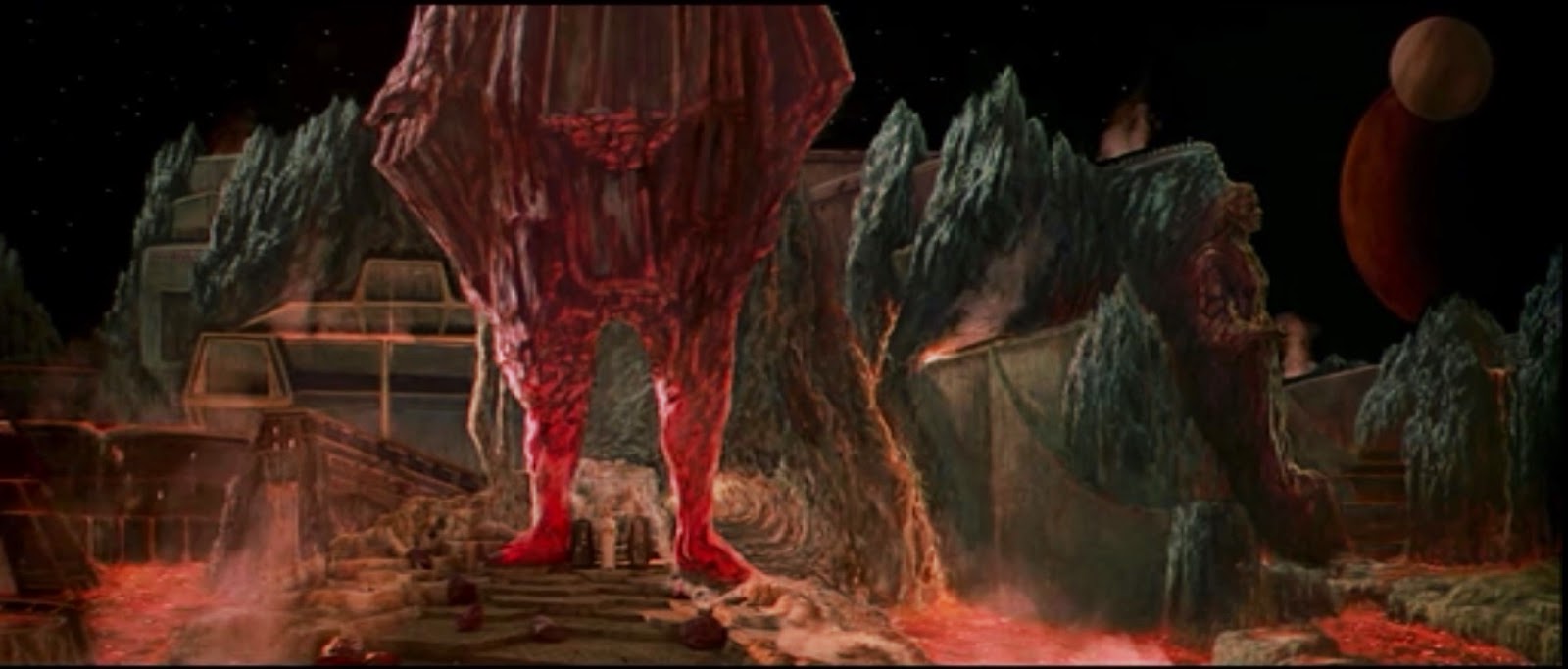
The first third of the movie is the 'getting the old gang back together' bit. Kirk has bulldogged Starfleet command into giving him control of the Enterprise again, (this is not shown) then runs into Scotty who drives him to the recently-updated Enterprise in a little space shuttle. The scene of the shuttle approaching the enterprise it quite interesting. It lasts about 5 minutes, and mostly cuts between shorts of Kirk getting teary-eyed at the sight of his old ship, and impressive special effects shots of the Enterprise as it sits in some kind of space drydock. This sequence is all visual spectacle. There is virtually no dialog, just shots of the Enterprise from every angle, set against orchestral arrangements of TV show's theme music, as the audience gazes in wonder at this new, post-Star Wars imagining of the Enterprise.
Once Kirk is aboard, Uhura, Sulu, Chekhov, etc, all greet him, expressing wonderment at his unexpected appearance. A grumpy, bearded Bones is quickly brought aboard, against his will, and then a bit later, Spock somehow tracks down the Enterprise and flies in using a another little space shuttle. Now that the original cast is completely reunited, the Enterprise sets off to stop the giant killer cloud. The remainder of the movie mostly consists of the journey to the center of the cloud, as the crew attempts to solve the mystery of the cloud before it reaches Earth.
Fans, critics and the cast itself generally did not like The Motion Picture. In theory, the story of an all-powerful yet unknowable alien lifeform menacing Earth could make for an exciting movie. Yet TMP is almost completely lacking in action and excitement. The crew of the Enterprise are reduced to spectators, watching passively as they drift through the alien cloud. Unlike most episodes of the TV show, the crew remains shipbound for the entire movie. Aside from one scene where the Enterprise gets sucked into a wormhole and has to fire photon torpedoes at an asteroid, everyone mostly sits in their chairs and stares at the bridge's big monitor screen. No phasers are fired, no red shirts are killed, Kirk doesn't engage in any fisticuffs or make love to any alien ladies. The returning cast had complaints about the script not giving them much to do. Uhura, Sulu and Chekov sit at their stations and do nothing other than provide the occasional reaction shot. Scotty remains stationed in the engine room and makes various comments about the engines not being at full power, etc. The only returning cast members who get any noteworthy dialog are Kirk, Spock, and Bones. Bones exists pretty much to squabble with Spock (which is fine) but mostly stands around on the bridge looking lost. Spock is the movie's deus ex machina, who had an unexplained psychic link to the cloud, and spends the movie telling Kirk what his next move should be.
First time viewers of TMP may be surprised at how much time it spends on the two new characters, Stephen Collins' Captain Decker and Persis Khambatta's Ilia. The source of the film's main dramatic conflict is the tension between Kirk and Decker after Kick re-assumes command of the Enterprise. Ilia herself is one of TMP's central images. With her shaved head and high collared white bathrobe outfit, she cuts a striking figure, and she was featured heavily in the film's promotions. Check the movie's poster up there: her face is plastered front and center right between Kirk and Spock's. It appears she was briefly being positioned to become a major star, with Star Trek TMP as her breakout role. She was considered for a role in an upcoming James Bond movie, but this never came to pass, and she mostly ended up in low-budget flicks after this. MST3K fans will recall her from Warrior of the Lost World, where she was upstaged by Megaweapon.
Ultimately, I'd say that Star Trek TMP's strange passivity is its greatest failing. I'll tie this in with a cinematic mini-trend that I have just now thought up: "The Cinema of Spectators." 2001 and Close Encounters of the Third Kind may be the greatest examples of this genre. In the Cinema of Spectators, characters are always staring, wide-eyed and opened mouthed, at some amazing sight unfolding before them. A character's goal may simply be to see something, rather than interact with it. Astronauts travel to the moon to look at the monolith in 2001. Later in that movie, Dave witnesses the secrets of the universe unveiling themselves, just as we viewers do. Dave acts as a stand in for the viewer. Compare Close Encounters with Spielberg's other films, which all involve some kind of spectacle, but non-passive characters. In Jaws, they want to kill the shark; Indiana Jones wants to steal the Ark, Eliot wants to help ET get back home. In contrast, Richard Dreyfus' character in Close Encounters leaves his entire life behind just to get a chance to witness the alien spacecraft again. The classic shot construction in such films is cutting back forth between the character's motionless gaze and the spectacle they are viewing.
This is exactly what happens in Star Trek: TMP. First we have Kirk and Scotty's surprisingly long shuttle trip around the Enterprise. The cloud's attacks on the Klingon warship and a Federation space station are both witnessed by people looking at viewscreens. Once the Enterprise enters the cloud, they cannot attack it or even really communicate with it. All Kirk can do is ponder the cloud's vast and wondrous interior spaces. These special effects scenes are the meat of ST: TMP. We are treated to countless expensive special effects shots of the enormous alien spaceship in the heart of the cloud. Deigned by Syd Mead, all this stuff is pretty amazing looking, but is treated mostly as background scenery. Even the film's ending finds Kirk and Spock behaving in a uncharacteristically passive way. Captain Decker sacrifices himself to save the Earth, while everyone else just stands there.*
Star Trek: The Motion Picture's over-reliance on spectacular visual effects over action and characterization makes it an interesting failure. I wouldn't call it boring, per se, but it is a bit frustrating. In some ways it resembles the original series more than the later films (it was sort of a rewrite of a TV episode called "The Changeling.") Regardless, it was not the mammoth success Paramount hoped it would be. The studio reacted by shit-canning Roddenberry, hiring new production staff, and slashing the budget for the sequel by 75%. The result was a film loved by fans young and old, which we'll cover next time.
*Spoiler alert! At the center of the gigantic space cloud is an enormous alien spacecraft piloted by a mysterious being called V'Ger, who takes over Ilia's body (sort of.) V'Ger is guiding the cloud to Earth to meet "the creator." Eventually the Kirk and the gang manage to come face to face with V'Ger, who turns out to be an old Voyager space probe (with dirt covering up the "oya" part of the logo) who went thru a black hole to the other end of the universe and somehow merged with some super-advanced race of sentient machines or something. Decker, as one of the human "creators," fuses with V'Ger, perhaps infusing him with human intelligence, and creating a new form of life. Spock stupidly muses that they may have just witnessed the next step in human evolution. Kirk, having completed his mission, decides to immediately hightail it to furthest reaches of space just like they did in the old days, despite having no orders to do so, and not taking into consideration that his crew members might have family members on Earth they might want to check on. (Earth was literally minutes from being vaporized by a super-powerful space being. I assume some crazy end-of-the-world shit went down on the surface while all this was going on.) The End.
This particular project was inspired by the estimable Bill Mudron, an artist you might know from his illustration of movie reviewer Mr. Plinkett. He does all kinds of art based on videogames and other nerdy stuff. He was talking about the Star Trek movies, and I mentioned I had not seen all of them, and probably have not seen any of them since their original release. Bill let me know that all the movies were currently available on Netflix streaming, which seemed like a good excuse for me to flesh out my Star Trek knowledge and then serve up my terrible Star Trek opinions. I'll start this today with 1979's Star Trek: The Motion Picture.
One caveat: I am not a Star Trek fanatic. I think Star Trek is OK. I will only be covering the six original ST movies, since I do not give one shit about the various spin-offs such as Next Generation, Babylon 5, Enterprise, etc. I will not engage in any Star Trek geekery here and will look at these movies with the cold, clear eye of a man who has no special attachment to any of them.
Of the six Star Trek feature films, Star Trek: The Motion Picture is the weirdest, and in some ways, most interesting, of the bunch. It was also the biggest money maker of the six, based on the original theatrical runs. It's the only one directed by a renowned filmmaker, namely Robert Wise, winner of two Best Director Oscars. Wise was an editor before he became a director, and one of his editing credits was Citizen Kane. Let that sink into your skulls for a moment. The guy who made the first Star Trek movie had Citizen fucking Kane on his resume. His lengthy directorial credits included the early sci-fi movie The Day the Earth Stood Still, as well as West Side Story and The Sound of Music. Just to remind you, The Sound of Music is, to this day, the third biggest money making movie of all time. Wise mostly made big, high budget, all-star movies, so bringing him aboard was a sign of Paramount's seriousness when it came to this movie.
![]() |
| Classic Bob Peak artwork on the poster. |
![]() |
| Star Trek was hugely popular among kids in the 70s |
Resurrecting Star Trek was a foregone conclusion by this point, and a protracted attempt to do so had begun around 1972. Plans to make a Star Trek film were jettisoned, but Paramount attempted to launch a new Trek TV series in 1977. In addition to the original cast, roles for new characters were created, such as Will Decker, and Ilia, who was to be played by Indian actress/model Persis Khambatta. The new series obviously never happened, since Paramount decided to opt for a theatrical movie instead, following the huge success of Star Wars and Close Encounters of the Third Kind. The intended first episode of the new TV series, "In Thy Image," was expanded into a film script. The new characters, Decker and Ilia were carried over. Gene Rodenberry was given the position of producer. Sets were hastily rebuilt. Paramount felt they were in a race against time, as they assumed the post Star Wars sci-fi movie fad would soon run its course.
![]() |
| Persis Khambatta in a test shot for the TV show project. |
Aside from Robert Wise, Paramount brought in some big names like special effects guy Douglas Trumbull, who previously worked on 2001 and Close Encounters. (Interestingly, his father worked on Star Wars.) Also Richard Yuricich from Close Encounters was hired and John Dykstra, from Star Wars, had some involvement. (Dykstra got the Star Wars job because Doug Trumball was already committed to Close Encounters. Special FX was an incestuous scene at the time.) The point is that Paramount was dedicated to making a Close Encounters-sized hit. The resulting picture was more expensive than Star Wars and Close Encounters combined. When it finally premiered in December 1979, it had the best opening weekend of the year. Star Trek: The Motion Picture made a nice chunk of money, but it wasn't exactly Star Wars money. It was generally considered a bit of a disappointment at the box office, since it only made $150 million, instead of $300 million. By comparison, it made more money, adjusted for inflation, than American Sniper or Guardians of the Galaxy.
Despite its relative financial success, the involvement of names like Roddenberry, Robert Wise, Doug Trumball and Syd Mead; its state of the art special effects, and fact that it succeeded in reuniting the original cast and restarting the franchise, Star Trek fans tend to really dislike The Motion Picture. As I mentioned at the top of this post, it's a weird movie, closer in some ways to Kubrick's 2001 than the rest of the Star Trek movies. It begins much like Star Wars, with special effects shots of spaceships flying through space, in this case Klingon battleships. Everything in this opening sequence looks expensive. The Klingons have more elaborate makeup than they did in the TV show; the interiors of the Klingon ship look great compared to the drab design and flat lighting ST fans were used to. The Klingon ships attack some mysterious space cloud and very quickly get themselves disintegrated by the cloud's unstoppable plasma bursts. We then cut to Earth, where Kirk, now an admiral, is preparing to return to active duty and take the Enterprise out to meet the mysterious cloud, which is headed on a course straight to Earth. Simultaneously, Spock is hanging out on Vulcan with a hippie haircut, doing Vulcan things.
![]() | |||
| Vulcan looks very matte-painty in this movie. |
The first third of the movie is the 'getting the old gang back together' bit. Kirk has bulldogged Starfleet command into giving him control of the Enterprise again, (this is not shown) then runs into Scotty who drives him to the recently-updated Enterprise in a little space shuttle. The scene of the shuttle approaching the enterprise it quite interesting. It lasts about 5 minutes, and mostly cuts between shorts of Kirk getting teary-eyed at the sight of his old ship, and impressive special effects shots of the Enterprise as it sits in some kind of space drydock. This sequence is all visual spectacle. There is virtually no dialog, just shots of the Enterprise from every angle, set against orchestral arrangements of TV show's theme music, as the audience gazes in wonder at this new, post-Star Wars imagining of the Enterprise.
![]() | |
| This sequence is a tour-de-force of cutting edge, post Star Wars special effects. |
Once Kirk is aboard, Uhura, Sulu, Chekhov, etc, all greet him, expressing wonderment at his unexpected appearance. A grumpy, bearded Bones is quickly brought aboard, against his will, and then a bit later, Spock somehow tracks down the Enterprise and flies in using a another little space shuttle. Now that the original cast is completely reunited, the Enterprise sets off to stop the giant killer cloud. The remainder of the movie mostly consists of the journey to the center of the cloud, as the crew attempts to solve the mystery of the cloud before it reaches Earth.
Fans, critics and the cast itself generally did not like The Motion Picture. In theory, the story of an all-powerful yet unknowable alien lifeform menacing Earth could make for an exciting movie. Yet TMP is almost completely lacking in action and excitement. The crew of the Enterprise are reduced to spectators, watching passively as they drift through the alien cloud. Unlike most episodes of the TV show, the crew remains shipbound for the entire movie. Aside from one scene where the Enterprise gets sucked into a wormhole and has to fire photon torpedoes at an asteroid, everyone mostly sits in their chairs and stares at the bridge's big monitor screen. No phasers are fired, no red shirts are killed, Kirk doesn't engage in any fisticuffs or make love to any alien ladies. The returning cast had complaints about the script not giving them much to do. Uhura, Sulu and Chekov sit at their stations and do nothing other than provide the occasional reaction shot. Scotty remains stationed in the engine room and makes various comments about the engines not being at full power, etc. The only returning cast members who get any noteworthy dialog are Kirk, Spock, and Bones. Bones exists pretty much to squabble with Spock (which is fine) but mostly stands around on the bridge looking lost. Spock is the movie's deus ex machina, who had an unexplained psychic link to the cloud, and spends the movie telling Kirk what his next move should be.
![]() |
| Psychedelic effects are used for the wormhole sequence. |
First time viewers of TMP may be surprised at how much time it spends on the two new characters, Stephen Collins' Captain Decker and Persis Khambatta's Ilia. The source of the film's main dramatic conflict is the tension between Kirk and Decker after Kick re-assumes command of the Enterprise. Ilia herself is one of TMP's central images. With her shaved head and high collared white bathrobe outfit, she cuts a striking figure, and she was featured heavily in the film's promotions. Check the movie's poster up there: her face is plastered front and center right between Kirk and Spock's. It appears she was briefly being positioned to become a major star, with Star Trek TMP as her breakout role. She was considered for a role in an upcoming James Bond movie, but this never came to pass, and she mostly ended up in low-budget flicks after this. MST3K fans will recall her from Warrior of the Lost World, where she was upstaged by Megaweapon.
![]() |
| People who were around in 1979 still think of ST:TMP as the "one with the bald lady." |
Ultimately, I'd say that Star Trek TMP's strange passivity is its greatest failing. I'll tie this in with a cinematic mini-trend that I have just now thought up: "The Cinema of Spectators." 2001 and Close Encounters of the Third Kind may be the greatest examples of this genre. In the Cinema of Spectators, characters are always staring, wide-eyed and opened mouthed, at some amazing sight unfolding before them. A character's goal may simply be to see something, rather than interact with it. Astronauts travel to the moon to look at the monolith in 2001. Later in that movie, Dave witnesses the secrets of the universe unveiling themselves, just as we viewers do. Dave acts as a stand in for the viewer. Compare Close Encounters with Spielberg's other films, which all involve some kind of spectacle, but non-passive characters. In Jaws, they want to kill the shark; Indiana Jones wants to steal the Ark, Eliot wants to help ET get back home. In contrast, Richard Dreyfus' character in Close Encounters leaves his entire life behind just to get a chance to witness the alien spacecraft again. The classic shot construction in such films is cutting back forth between the character's motionless gaze and the spectacle they are viewing.
![]() |
| Some moments almost feel lifted straight out of 2001. |
This is exactly what happens in Star Trek: TMP. First we have Kirk and Scotty's surprisingly long shuttle trip around the Enterprise. The cloud's attacks on the Klingon warship and a Federation space station are both witnessed by people looking at viewscreens. Once the Enterprise enters the cloud, they cannot attack it or even really communicate with it. All Kirk can do is ponder the cloud's vast and wondrous interior spaces. These special effects scenes are the meat of ST: TMP. We are treated to countless expensive special effects shots of the enormous alien spaceship in the heart of the cloud. Deigned by Syd Mead, all this stuff is pretty amazing looking, but is treated mostly as background scenery. Even the film's ending finds Kirk and Spock behaving in a uncharacteristically passive way. Captain Decker sacrifices himself to save the Earth, while everyone else just stands there.*
![]() |
| Countless scenes like this made ST:TMP cost more than Star Wars and Close Encounters combined. |
Star Trek: The Motion Picture's over-reliance on spectacular visual effects over action and characterization makes it an interesting failure. I wouldn't call it boring, per se, but it is a bit frustrating. In some ways it resembles the original series more than the later films (it was sort of a rewrite of a TV episode called "The Changeling.") Regardless, it was not the mammoth success Paramount hoped it would be. The studio reacted by shit-canning Roddenberry, hiring new production staff, and slashing the budget for the sequel by 75%. The result was a film loved by fans young and old, which we'll cover next time.
![]() |
| Lens flares, years before JJ Abrams. |
*Spoiler alert! At the center of the gigantic space cloud is an enormous alien spacecraft piloted by a mysterious being called V'Ger, who takes over Ilia's body (sort of.) V'Ger is guiding the cloud to Earth to meet "the creator." Eventually the Kirk and the gang manage to come face to face with V'Ger, who turns out to be an old Voyager space probe (with dirt covering up the "oya" part of the logo) who went thru a black hole to the other end of the universe and somehow merged with some super-advanced race of sentient machines or something. Decker, as one of the human "creators," fuses with V'Ger, perhaps infusing him with human intelligence, and creating a new form of life. Spock stupidly muses that they may have just witnessed the next step in human evolution. Kirk, having completed his mission, decides to immediately hightail it to furthest reaches of space just like they did in the old days, despite having no orders to do so, and not taking into consideration that his crew members might have family members on Earth they might want to check on. (Earth was literally minutes from being vaporized by a super-powerful space being. I assume some crazy end-of-the-world shit went down on the surface while all this was going on.) The End.
Subscribe to:
Posts (Atom)


